
 Gina Dean
Samar Governor Sharee Ann Tan appeared determined to keep the five wind turbines within the protected area of Calbayog Pan-as Hayiban.
Acting as representative for Vena Corporation, she held negotiations with Calbayog stakeholders on Monday, along with the city and provincial officials. Following acknowledgment of all the flaws and irregularities, the Protected Area Superintendent and secretariat of PAMB were removed due to alleged deceptive transactions involving the wind farm project.
“I will write to the DENR for the immediate removal of the PASU because I don’t think he still has the trust of the people. I am now looking for a replacement for PASU,” Tan stated.
According to her, the alleged improper rezoning allowed for the approval of the Environmental Compliance Certificate (ECC) and the Special Use Agreement in Protected Areas, which were announced during the public consultation.
However, when the city government withdrew support for the project, down to the host barangays, it prompted her to seek reconsideration on behalf of the proponent.
Why insist when the affected communities have already spoken?
The overwhelming support from various organizations and environmental groups served as a guide for the council to decide and halt the project in the protected area. Judge Odelon Mabutin questioned who the real stakeholders in the issue were.
“Since the Sanggunian Panlungsod of Calbayog has already taken their stand, we should give great weight to Calbayog’s position, as they are the representatives of the populace of Calbayog, especially considering the 12 organizations that have issued statements of support,” Mabutin emphasized.
Judge Mabutin advised the governor that future generations should always be prioritized in development decisions, and therefore, forest reserves and conservation areas should be safeguarded from any individual’s interests.
The dialogue highlighted key issues that Governor Tan will present to Vena Corporation, such as identifying three sites in Calbayog for the relocation of 13 wind turbine generators outside the protected area, requiring Vena Corporation to submit an Environmental Impact Statement for the road networks, a share of user fee for the host city and a direct line from the plant to the local power distributor.
During the public scoping in Calbayog, stakeholders specifically inquired about receiving benefits such as lower power rates or free electricity for impacted barangays. The proponent, GWEC, clarified that they are solely energy producers or generators and cannot influence the price of electricity or compel the local distribution utility (DU) to source power from the plant. The proponent mentioned that providing free electricity is unlikely, but they would discuss the issue with management.
Notably, this issue was not brought up by PAMB to the DENR Regional Office 8 or any other concerns until the ECC and SAPA were approved. The 20 billion worth of the wind farm project was seen as “mouthwatering”, disregarding the lives of Calbayognon.
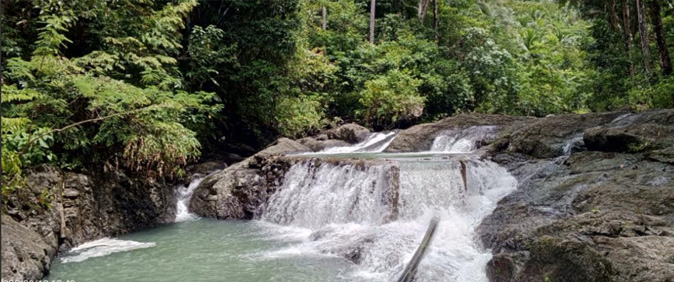
The possibility of coexistence between a wind farm and water system relies on strict, transparent, and continuous hydrological monitoring—something the current operational plan does not yet ensure. The 2019 research of the Pan-as Forest Watershed Reserve indicates that once Calbayog’s backbone is penetrated, it would lead to reduced forest cover, disturbances on higher slopes, and long-term economic costs due to water insecurity.


 Calbayog LGU, SAMELCO I Discuss Rising Power Rates
  Five Calbayognon Women Take Home Crowns in Hadang Festival 2026
 Calbayog activates disaster preparations ahead of Super Typhoon ‘Bavi’
  Calbayog Vice Mayor Checks Hotels, Pushes Plan to Turn City into Region 8’s Mice Hub
  The Price of a Spectator Seat: Calbayog’s Sovereignty in the Shadow of Wind Turbines