 Gina Dean
‘How can a resolution be revoked when an ECC was already issued?’
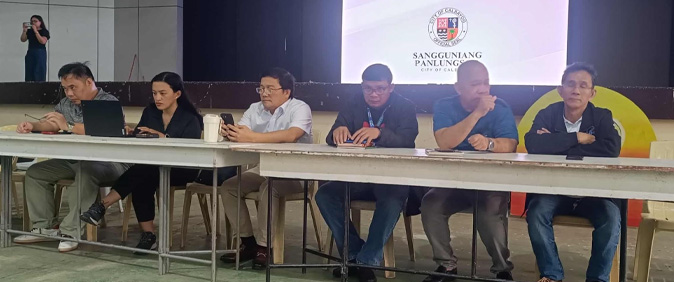
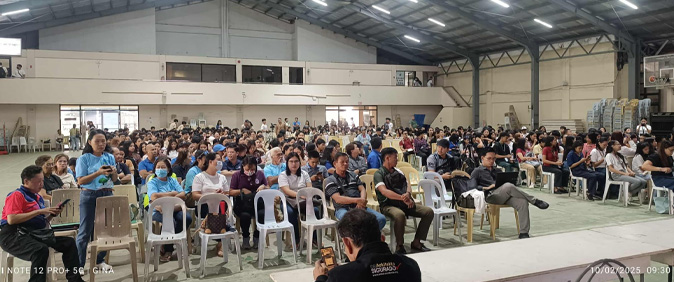
That question echoed across the Northwest Samar State University Socio-Cultural Center on October 2, as the public gathered in hopes of stopping a wind energy project within the Calbayog Pan-as Hayiban Protected Landscape (CPHPL)—only to be met with silence.
What was intended as a public hearing on the city’s endorsement of Gemini Wind Energy Corporation’s (GWEC) 37-turbine project turned into a tightly controlled event. Officials confirmed that the Department of Environment and Natural Resources – Environmental Management Bureau Region 8 (DENR–EMB RO8) had already granted an Environmental Compliance Certificate (ECC) on September 12, 2025, effectively fast-tracking the project despite mounting environmental and legal concerns.
The event, convened by the Sangguniang Panlungsod at the request of Calbayog Mayor Raymund Uy, was expected to address public appeals for the revocation of Resolution No. 2023-16-139. The resolution, dated May 24, 2023, endorsed Gemini’s wind studies and preliminary activities in the city.
Instead, participants were shocked when Councilor Eduardo Tibo declared that no public comments would be allowed, and questions were only to be submitted in writing. “We came here to participate in a democratic process,” said one environmental volunteer. “But we were silenced. The decision feels predetermined.”
‘Critical gaps in environmental review‘
Among the strongest objections came from Prof. Harold Mercurio of Samar Island Heritage Center Inc., who revealed that the road network for the 24 wind turbines has no clear Environmental Impact Assessment as the EIA/EIS (Environment Impact Statement) focused only on the immediate footprints of the wind turbine towers. The road network connecting the turbines obviously lacks details as to its EIA/EIS based on Gemini’s own submission to DENR-EMB RO8.
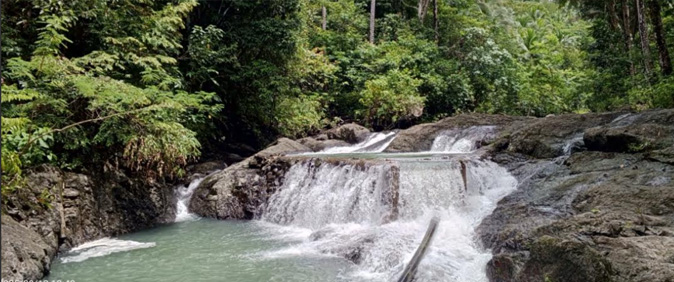
Worse, Mercurio said that 7 turbines previously fall within a Strict Protection Zone, a designation that prohibits large-scale development to safeguard biodiversity and water resources.
“These areas were reclassified in the 2024 CPHPL zoning to expand the multiple-use zone,” said Mercurio. “The adjustment appears to favor GWEC’s entry and SAPA (Special Use Agreement in Protected Areas) application—without genuine public consultation or proper information campaigns.”
Earlier this year, a dialogue was held between Samar Governor Sharee Ann Tan, Calbayog City Water District, and local environmental groups regarding the location of 13 turbines inside the watershed.
Governor Tan had appealed for collaboration to relocate the turbines outside the protection zone:
“Pwede ba liwat kami manghangyo ha iyo… kun hain an other alternative location nga pwede butangan hiton? We will ask Vena [GWEC] to come down here and engage with you to assure that Calbayog’s water supply is not threatened.” This discussion, however, was not mentioned during the October 2 public hearing, raising further concerns over transparency and the intent of the proponents. water resources.
“From the original CPHPL map of 2022 these areas were reclassified in 2024 to expand the multiple-use zone,” said Mercurio. “The adjustment appears to favor GWEC’s entry and SAPA (Special Use Agreement in Protected Areas) application—without genuine public consultation or proper information campaigns.”
Earlier this year, a dialogue was held between Samar Governor Sharee Ann Tan, Calbayog City Water District, and local environmental groups regarding the location of 13 turbines inside the watershed.
Governor Tan had appealed for collaboration to relocate the turbines outside the protection zone:
“Pwede ba liwat kami manghangyo ha iyo… kun hain an other alternative location nga pwede butangan hiton? We will ask Vena [GWEC] to come down here and engage with you to assure that Calbayog’s water supply is not threatened.”
This discussion, however, was not mentioned during the October 2 public hearing, raising further concerns over transparency and the intent of the proponents.
ECC vs. public will
The issuance of the ECC has intensified questions: Can a city revoke its endorsement once national agencies have already approved the project? Legal experts say the ECC grants significant authority, but local endorsements—especially those clouded by procedural concerns—can still be contested.
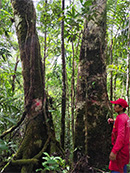
Community members worry that the project could lead to the cutting of over 5,000 trees and threaten the city’s water source. The approval of the project now hinges on the Certificate of No Objection from barangay officials within the vicinity.
“We are not against wind energy,” said a local science teacher. “We support clean energy—but not if it risks our watershed, biodiversity, and our right to be heard.”
As the turbines loom over the horizon, the people of Calbayog remain watchful. Their plea is not to stop progress—but to ensure it does not come at the irreversible cost of their environment.