
 Gina Dean
How are we going to protect our forest reserves over the interests of corporations when the agency concerned uses bureaucracy to serve their personal interest and those in power?
The people are now concerned. Who will protect nature from exploitation? Calbayog has its own natural cultural heritage – the Calbayog Pan-as Hayiban Protected Landscape (CPHPL), which covers a total area of 5,067.92 hectares.
The park possesses outstanding beauty and natural features of national and international significance because of its scenic grandeur and natural features, which are suited for tourism, economic, recreation, and educational upliftment of nearby residents.
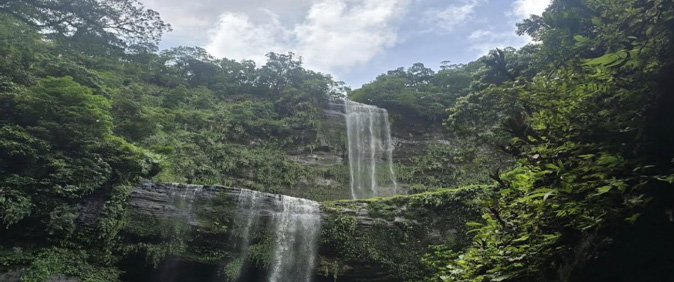
Aside from majestic caves, the most striking features of the park are its cascading waterfalls, specifically Pan-as Falls, Diit Falls, Cagdaras Falls, and Ton-ok Falls.
Just recently, the local government of Calbayog, through the city mayor, has initiated an executive consultation which intends to hear the sentiments of the people about the 37 wind turbine project of Gemini Wind Energy Corporation in Calbayog, specifically located in Baay, Bayo, Bugtong, Cag-anibong, Caglanipao Sur, Danao II, Manuel Barral Sr., Pilar and San Joaquin.
Based on the Gemini Wind Power Project (GWPP), 18 barangays are covered as host communities, for it involves the construction of several major structures, support facilities, and ancillary infrastructure across the project site in Calbayog City, Samar, and San Isidro, Northern Samar.
The infrastructure to be built includes the primary power generation components, grid connection infrastructure, and various permanent and temporary support facilities.
The overall development plan also includes provisions for energy storage facilities, such as batteries and other technologies, which may be developed at a later stage should the technology become commercially viable.
When this project was presented for the first time at Northwest Samar State University, Calbayog, in the so-called public hearing, the people were surprised that it immediately obtained a favorable response from the city officials in May 2023.
The provincial government also approved GWPP in November 2024 through a resolution endorsing said project in Calbayog Pan-as Hayiban Protected Landscape.
Now that GWEC has already obtained the Environmental Compliance Certificate (ECC) from the DENR – Environmental Management Bureau RO8, would the revocation of endorsement (if granted) be crucial to the project, and to the ECC itself?
Calbayog Mayor Raymud Uy admitted he was the one who requested the council to endorse the wind turbine project of Gemini Wind Energy Corporation.
Ako gin-aako ko ngan ayaw niyo basula an council, an Sangguniang Panlungsod. Kun mayda man angay basulon ako, kay ako nag-endorse sa ira, nagrequest for the endorsement through a resolution. So gin-aako ko. Ako an basula. Pero kitaa niyo an resolution. Mayda ba didto nakabutang nga didto nakabutang, o didto ibutang an mga turbine sa protected area? Para klaro la ba.
But Father Noel Labendia asked the city officials, “Why approve the project when you do not fully understand it?”
“Kay naman nag-approve kamo nga waray kamo mamati kun ano iton nga proyekto? Kay ano nga nagresolution kamo nga diri man ngay-an kamo sayud? Kay pwede man sumiring nga diri anay kami maaprove unless matapos anay iyo study. Kay legal ito, pero patitinaw-an la kita. Makaaawud.”
They are now pointing fingers. The mayor said his representative to the Protected Area Management Board (PAMB) did not inform him of the specific details of the project, especially the issues raised by the civil society and the academe during PAMB meetings.
The Sangguniang Panlungsod members also refused to admit the gap. They said that the resolution was just an expression of support to the project, but did not include the building of wind turbines in the protected area.
The sangguniang panlungsod might have overlooked their primary role which includes – to conduct inquiries in aid of legislation.
Professor Ronald Orale of Samar State University said that the city and the province should have required the GWEC to submit a feasibility study, the technical side of the proposal. In the absence of such a document, government officials should not decide to approve the project. City officials should look into the impact of the project on the watershed.
“Any development project should have technical studies na ginawa truthfully. Dapat maipakita para malaman kung ano ang magiging impact niya sa environment. Kasi kung wala yon, dapat highly cautious ang pag-approve,” he added.
The people of Calbayog have spoken. There is an urgent need to stop the project. The 13 wind turbines which will be installed in the Strict Protection Zone (SPZ) of the Calbayog Pan-as Hayiban Protected Landscape will surely have an irreversible impact to the watershed, the main source of water and life of all Calbayognon.
Based on the Gemini Wind Power Project: Environmental Impact Assessment Scoping, the project involves utilizing a 5.59-km existing access road connecting to Maharlika Highway in Calbayog City, and constructing a 46 km internal site road network sprawled across the project area.
The project proponent has not yet finalized or disclosed the specific number of trees (including mature trees) that must be cut down for the construction of the road networks and the wind turbine area.
When asked about estimating the size of the old-growth forest affected, the proponent stated, “We do not have the details yet on the area of forest cover to be affected since the studies are still ongoing”.
Awaiting the Calbayog City council’s decision – will they find merit to the petition submitted by Save Calbayog Rivers Foundation, Inc.?
The executive act that the people are asking for from the mayor would somehow ensure that the cutting of trees in protected areas can be prevented. But Uy said that the existing national law would matter than an executive order.
Be it noted that the local government has the autonomy to protect the environment and impose appropriate penalties for acts that endanger the environment.

