

 Jazmin Bonifacio
Posted on November 21, 2026 at 08:17 AM
Kananga, Leyte — Trainees at a technical-vocational school in Leyte start their day with early morning formation, physical exercises, and a strict schedule that may remind some of the routine at the Philippine Military Academy (PMA).
At the KEITECH Educational Foundation Inc., waking up before sunrise, following orders, observing discipline, and setting aside mobile phones are part of everyday life.
The school imposes a military-style routine on young people enrolled in its residential training program, where learning a trade goes hand in hand with developing discipline, responsibility, and proper work habits.
For some trainees, adjusting to the rules is difficult. But for those who want to find work and help their families, the program offers a chance to learn practical skills and prepare for life outside the classroom.
Atty. Allan V. Barcena, assistant vice president and head of corporate support functions of Energy Development Corporation (EDC) and president of Keitech, said the daily routine is meant to teach trainees discipline and responsibility.
“Military routine for us is a good source of instilling discipline,” Barcena said.
Not everyone, however, can easily adjust to the system.
During the first few weeks, some trainees decide to leave because they find it difficult to wake up early, follow sleeping schedules, stay away from their mobile phones, and comply with the school’s rules.
Barcena said serious violations could lead to suspension or dismissal. But he also acknowledged that discipline must have limits, as too much control could discourage trainees and make them resist the program.
For him, the goal is not simply to make young people follow orders. They must also learn to manage their time, take responsibility for their actions, and develop habits that will help them once they enter the workforce.
LIVING AND LEARNING TOGETHER
Training at Keitech goes beyond technical lessons.
Unlike students who attend classes and return home, trainees live inside the campus in shared bunkhouses designed to resemble accommodations at construction sites.
They cook their own meals, clean their surroundings, and learn to live with people who come from different backgrounds.
Their daily activities include physical exercises, technical training, and evening sessions on values formation. The school also organizes activities such as karate, swimming, and ballroom dancing to help trainees build confidence and improve their social skills.
Barcena said the program also teaches what he considers basic human decency, including how to communicate properly, show respect, and carry oneself in different situations.
Despite the strict routine, trainees are allowed to raise questions, express their opinions, disagree with instructors, and give feedback about the program.
Barcena said discipline should not prevent students from thinking for themselves. He wants them to learn when to follow instructions and when to speak up.
LEARNING TO FACE FEAR
For Alvin Mariquit, one of Keitech’s graduates, enrolling in Tourism meant taking on a challenge he had long struggled with: speaking in front of other people.
Coming from a farming family, Mariquit said he was not naturally confident when communicating with others.
Instead of choosing a course that would keep him within his comfort zone, he chose Tourism, a field that requires constant interaction with people.
He knew it would not be easy, but he wanted to improve himself.
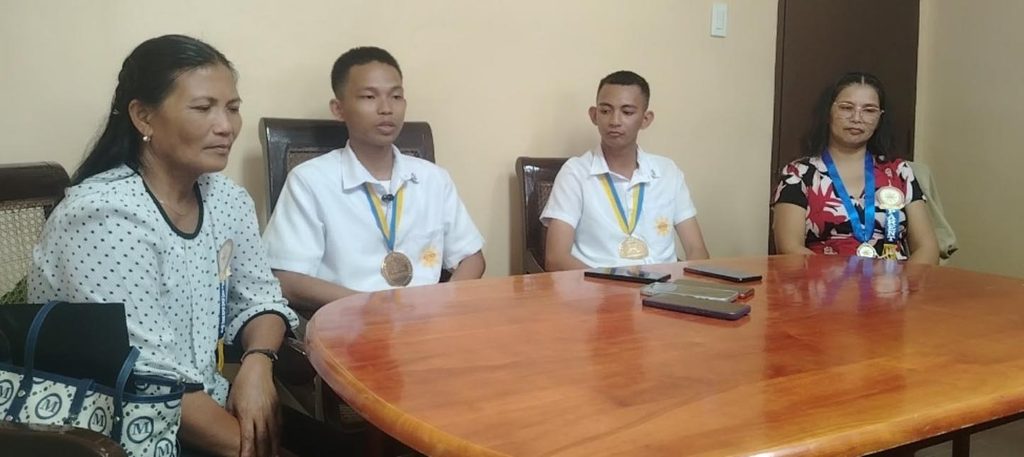
His efforts paid off when he received the Federico R. Lopez Award for his outstanding performance during his on-the-job training.
After graduation, he received job offers from hotel agencies in Cebu City. He has also been considering opportunities in Ormoc City while weighing the cost of living and other expenses involved in working outside his hometown.
Mariquit said poverty should not prevent young people from pursuing their ambitions.
“Poverty should not stop you from dreaming; it should motivate you to keep moving forward in whatever way possible. If I just stay in my comfort zone, I won’t be able to move forward,” he said.
STARTING FROM THE GROUND UP
Mark Vincent De Guia also had to make difficult choices before finding his direction.
After experiencing financial difficulties and an initial academic rejection, he decided to take Electrical Installation and Maintenance under Keitech’s Construction sector.
During his interview, school staff questioned why he wanted to enter construction instead of Tourism, considering his ability to communicate well.
But De Guia was determined to learn electrical systems and pursue the trade.
His efforts earned him the Oscar M. Lopez Award as one of the program’s outstanding graduates.
He later received a job offer from Seatrium Shipyard in Zambales. However, he decided to start his career as a safety marshal under his mentor, Engineer Ray, at BalCorp.
Rather than immediately pursuing a higher position, De Guia wanted to gain experience and learn the job from the ground up.
For him, technical knowledge alone is not enough to succeed in the workplace. Workers must also have the right attitude and values.
“No diploma is just a diploma. I will not degrade those striving for a four-year degree, but in a practical way especially nowadays institutions like Keitech offer a vital lifeline. What good is a skill if you lack values? You must couple skill with character to achieve true success,” he said.
ANOTHER WAY TO ENTER THE WORKFORCE
Keitech offers an almost 11-month training program in different fields, including carpentry, masonry, electrical installation, and welding.
The program is funded by EDC and provides trainees with technical instruction, accommodation, and industry-based on-the-job training.
Based on the program data, more than 80 percent of its graduates find employment in local companies, overseas workplaces, or through their own businesses.
Some graduates eventually become supervisors or managers. Others use their earnings to help support their families. A number also return to the school to share their experiences with younger trainees.
For young people who cannot afford a college education or have stopped schooling because of financial difficulties, technical-vocational training offers another way to prepare for employment.
The experiences of Mariquit and De Guia show two different paths taken by young people who wanted to improve their lives. One chose a field that forced him to overcome his fear of speaking in public, while the other pursued a technical trade and chose to gain work experience before moving to higher positions.
At Keitech, trainees are expected to follow a strict routine, from early morning drills to their evening activities. But once they leave the school, they must put what they have learned into practice.
For them, graduation is not the end of the training. It is the beginning of finding work, earning a living, and helping their families.
Photo by: Jazmin Bonifacio


 Two young basketball players from Dulag head to Bangkok
 Drought, Power Shortages Threaten to Raise Utility Costs in Eastern Visayas
 Solar Irrigation Projects Strengthen Drought Preparedness in Eastern Visayas
 DOST Weather Stations to Help Farmers Beat Dry Spells
 Being Martin Romualdez isn’t a Crime, Due Process Must Outrun Public Prejudice
 Eastern Visayas Army Chief Urges Soldiers, Youth to Uphold WWII Veterans’ Legacy