
 Rolly Magallanes
Posted on November 09, 2026 at 01:53 PM
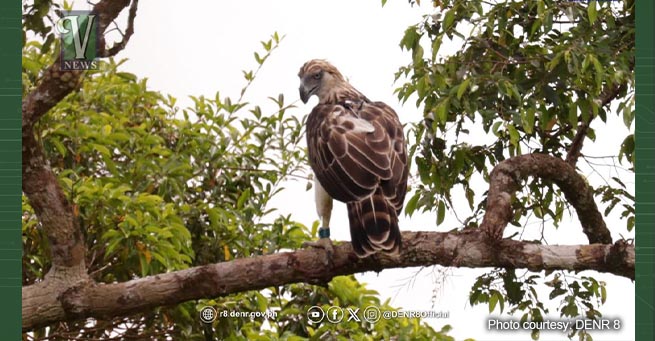
Tacloban City — Leyte’s forests could once again become home to the critically endangered Philippine Eagle, but protecting its potential habitat will be just as important as bringing the bird back to the island.
A scientific study has identified 10,320 hectares of potential release sites in the Anonang-Lobi Mountain Range in Central Leyte and Mt. Nacolod in Southern Leyte.
Published in the June 2026 issue of the Philippine Journal of Science, the study found that 9,554 hectares were highly suitable for eagle release, while another 766 hectares were classified as suitable but would need further monitoring and community education.
The findings offer hope for the return of the country’s national bird to Leyte, where it was considered locally extinct following the devastation caused by Super Typhoon Yolanda in 2013.
However, finding suitable release sites is only one part of the work. The forests must also be protected from activities that could destroy the eagles’ habitat and threaten their survival.
The identified areas in the Anonang-Lobi Mountain Range cover portions of Ormoc City, Albuera, Kananga, Jaro, Burauen, and Baybay City. The mountain range is recognized as a Key Biodiversity Area and a priority habitat for the Philippine Eagle Foundation.
In Southern Leyte, potential sites were identified in Mt. Nacolod, particularly in Silago, Mahaplag, and Sogod. The mountain has old-growth, secondary, and mossy forests that provide shelter for wildlife and help protect important watersheds.
The researchers also looked into possible dangers to the birds, including electrocution from power lines. Since complete power line data were unavailable, they used road networks to identify areas where smaller distribution lines might be present.
The study also identified 13 possible helicopter landing sites near the proposed release areas to help transport eagles during reintroduction.
But protecting the forests will require more than scientific studies and maps. The researchers pointed to the need for cooperation among local governments and communities, whose participation is important in keeping the habitats safe.
Barangay Kagbana in Burauen shows how local communities can take part in these efforts. Waray and Mamanwa residents have helped protect the Philippine Eagle, with the Mamanwa community involved in conservation activities since 2017.
The barangay has also become part of the eagle reintroduction program, with birds released in June 2024 and May 2025.
Their involvement shows why people living near the forests must be part of conservation efforts. Protecting the Philippine Eagle also means protecting the land and forests that local communities depend on.
For Leyte, the challenge now goes beyond finding places where the eagles can be released. The government, conservation groups, and local communities must work together to make sure these forests remain safe for the birds to return and survive.
Photo Courtesy: DENR 8


 Northern Samar Braces For Five-Month Drought As El Niño Persists
 Romualdez Offices, Tingog Join Tacloban in 13th Yolanda Commemoration
 13 Years After the Storm: Palo Mass Grave Remembers Yolanda Victims
 M/V EVA JOCELYN: A Yolanda Shipwreck That Became A Tacloban Landmark
 FROM OPEN WATERS TO SHORE : Mapping the Maritime Routes Behind Drug Seizures in Eastern Visayas (2/3)
 DOH Brings Free Healthcare to Mamanwa Communities in Samar