
 Jazmin Bonifacio
 Posted on Apr. 20, 2026 at 11:08 pm

TACLOBAN CITY — In the heart of Catbalogan stands Pieta Park, a modest open space that carries a weight far larger than its size suggests. To passersby, it may appear as just another corner of the city. But for many families, it has long served as a place where grief was given form, where silence carried the names of the lost, and where memory refused to fade into history.
Long before it became the subject of redevelopment plans and legal disputes, Pieta Park was known as a quiet memorial ground for those affected by the sinking of the MV Doña Paz, often described as “`”Asia’s Titanic.”
The tragedy claimed thousands of lives in 1987, including many from Samar, leaving behind families who never recovered remains, never received full answers, and never truly found closure.
For them, Pieta Park became more than symbolic. It became physical proof that their loved ones were remembered.
At its center stood the La Pieta statue, an image of mourning that mirrored the collective sorrow of the community. Over the years, the site evolved into a place of ritual remembrance. Candles were lit at dusk, prayers were whispered in the heat of the day, and families returned not out of habit, but out of need. It was one of the few spaces where absence felt acknowledged rather than ignored.
But in recent years, that meaning has come under threat.
Pieta Park now sits at the center of a growing dispute over redevelopment plans that seek to transform the area into a commercial space. Supporters of the project describe the site as underutilized and in need of modernization, arguing that development could bring economic activity while retaining a smaller memorial corner.
Opponents see something else entirely: the slow conversion of a sacred space into a business opportunity.
However, the park’s future is now uncertain as it faces potential redevelopment that threatens to erase its historical and cultural significance. Lawyer Alma Uy, who has taken up the legal battle to protect the site, says Pieta Park is facing a transformation that would erase its meaning entirely.
In a strongly worded statement, she described the forces behind the redevelopment as powerful and determined, noting that “sure victory is already being expected by those pushing for reclassification.”
“They called Pieta Park a nuisance,” Uy said, “and described it as filthy, justifying plans to turn it into a commercial site. But this is not just land. This is memory. This is history.”
Uy has filed legal actions to stop the reclassification of the park for commercial use, including a motion to implead businessman Gildo Arais, the franchisee of a planned Shakey’s Pizza outlet.
She cited a lease agreement reportedly valued at P90,000 per month over 15 years, arguing that financial gain cannot outweigh the cultural and emotional value of the site.
Despite the case, Uy expressed frustration over what she described as prolonged inaction by the court on her petition for a Temporary Restraining Order, which has remained unresolved for nearly six months.
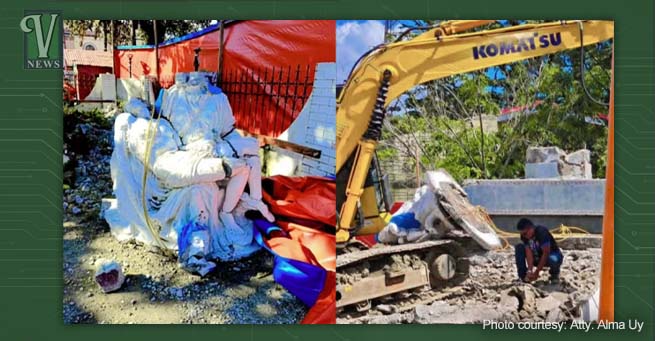
As the legal battle unfolds, tensions have intensified on the ground. Reports emerged that the La Pieta statue was forcibly removed from its pedestal during early development activity at the park.
Uy said it was later found damaged and covered, its once solemn presence reduced to something barely recognizable.
For many residents, the act felt less like construction and more like erasure. “This is the broken La Pieta,’ Uy said, referring to the statue now shrouded from public view.
`It stood there for years as a witness to grief. Now it is treated as if it never mattered.”
The controversy has drawn wider opposition. Relatives of Doña Paz victims, including Lourdes Ty Singzon, have voiced concern over the redevelopment. Local historians such as Jhonil C. Bajado and Charo Cabardo, along with Professor Ronald Libanan Orale, have also emphasized the site’s historical and cultural importance, urging officials to preserve it as a heritage space. They argue that Pieta Park had already been recognized by the city council in the past as an important open space with cultural value and was even considered for classification as an important cultural property.
City officials and supporters of the project, however, maintain that redevelopment is necessary. They describe the park as underutilized and in need of improvement, suggesting that commercial investment could coexist with a smaller memorial area.
But critics see a deeper issue at stake. What happens when remembrance is reduced to make way for commerce?
For Uy, the matter is not merely legal, it is moral. “Why is it that small vendors are treated harshly for minor violations,’ she asked, `while those with greater influence can alter a sacred space with little consequence?”
She also raised concerns about what she described as selective enforcement and disregard for the National Heritage Act, calling on the Ombudsman to investigate possible violations by city officials and private stakeholders involved in the project.
(Photo courtesy: Atty. Alma Uy)


 Help Arrives for 12 Families After July 2 Fire in Apitong as Community Comes Together
  Comelec to Look Closely at Candidate Behavior in Identifying BSKE Hotspots
  ESNCHS Declared Safe After Bomb, Gun Threat Scare
  Romualdez Pushes Stronger Child Protection, Mental Health Reforms After School Tragedy
  BJMP Tacloban Stops Another Attempt to Bring Drugs into Jail
  Daram Shellfish Safe Again as BFAR Lifts Ban, But Nearby Areas Still Hit by Red Tide