
 Jaspher Deculawan
 Posted on May 27, 2026 at 1:01 pm
When truth is silenced, ordinary people lose not only information but also their voice, awareness, and ability to hold those in power accountable.
For many, press freedom is seen as an issue that concerns only journalists. However, during the observance of World Press Freedom Day 2026 led by BS Development Communication (DevCom) students at Northwest Samar State University (NwSSU), the conversation expanded beyond the media and focused on the communities that suffer when the truth becomes hard to find.
Held on May 18 at the BDC fourth floor and oval grounds, the event gathered students, faculty members, campus journalists, and guests for an observance centered on truth, civic participation, and responsible communication.
Students walked through exhibits featuring journalists who were killed, harassed, and red-tagged despite constitutional protections for press freedom. Nearby, a freedom wall allowed students to write messages, frustrations, and calls for accountability regarding issues affecting both the nation and the academic community.
The activity raised a troubling question: if journalists are silenced, who informs the public?
Truth Under Threat
For first-year DevCom student Kirk Tangzo, the exhibit aimed to help people understand the violence journalists continue to face simply for telling the truth.
In an interview, Tangzo explained that their presentation focused on journalists who became victims of harassment and attacks while fulfilling their responsibility to the public.
“An amon in papakita na essence… how much an violence na nabibring na nakakadto sa journalist na ira manla trabaho is to bring out the truth,” Tangzo said. (“The essence of what we are showing is how much violence is directed toward journalists whose only job is to bring out the truth.”)
According to data cited by the National Union of Journalists of the Philippines (NUJP), at least 189 journalists have been killed in the country since 1986, while other monitoring groups place the number even higher. The Philippines also remains among the world’s deadliest countries for journalists.
Tangzo added that the freedom wall encouraged students to participate in conversations about violence against journalists and broader social issues.
“No one should be above the law,” he said, emphasizing that peace becomes impossible when rights intended to protect people are violated.
Across the country, journalists continue to face red-tagging, intimidation, online harassment, and threats while misinformation spreads rapidly across digital spaces consumed daily by ordinary Filipinos. In a 2025 report, the Center for Media Freedom and Responsibility (CMFR) and NUJP documented 184 attacks against media workers from 2022 to 2025, including red-tagging, cyberattacks, harassment, death threats, arrests and censorship.
Perhaps most alarming is how attacks against journalists no longer shock the public the way they used to.
As students reflected on the exhibits, another question emerged: what happens to communities when fear becomes stronger than free expression?
Voices of the People
The event also emphasized that attacks against journalists ultimately affect ordinary people who rely on factual reporting to understand issues shaping their lives, education, and future.
“Students are not just passive observers within the academic community, they are stakeholders who are impacted by the issues and decisions of governance and education,” said Development Communication instructor Ma’am Gina Dean.
Dean said students must remain engaged in conversations about issues affecting them in order to strengthen civic participation and accountability.
“So kamo an aware san mga panhinabo, so therefore kamo an may katungod to express your opinion,” Dean said in an interview. (“You are aware of what is happening, therefore you have the right to express your opinion.”)
She also warned about the growing spread of misinformation, deepfakes, and manipulated online content that continue to blur the public’s understanding of truth.
“Even students cannot determine nano an truth, ngan nano an fake,” she said. (“Even students cannot determine what is true and what is fake.”)
As fake news spreads faster than verified reporting, people begin doubting legitimate journalism and struggle to distinguish truth from manipulation.
In a society where facts are constantly questioned, can communities still make informed decisions and move forward together?
Journalism Beyond the Newsroom
The same message was echoed in a statement of support from Ricky Bautista, president of the Region 8 Media Citizens Council (R8MCC), who emphasized the importance of responsible journalism during times of confusion and uncertainty.
According to Bautista, journalism serves communities not only by reporting events, but also by protecting the people’s right to know and helping citizens understand the realities around them.
“Journalism is not only about reporting events. It is about protecting the people’s right to know, promoting accountability, defending human rights, and helping citizens understand what is happening around them,” Bautista stated.
He added that harassment and intimidation against journalists weaken democracy by discouraging critical voices from speaking out.
These realities were further reflected in the statement delivered by The Courier Editor-in-Chief Carol Perito, who shared the experiences of campus journalists handling sensitive and controversial stories.
Perito explained that intimidation does not always come through direct threats. Sometimes, it exists through silence, fear, and pressure designed to discourage journalists from pursuing important stories.
“They want us to stay in our lane, stick to ‘safe’ topics, and keep our heads down,” Perito said.
Still, she emphasized that journalism remains essential because communities depend on truthful information to understand social realities and hold institutions accountable.
Citing Nobel Peace Prize laureate and Rappler CEO Maria Ressa, Perito reminded the audience:
“Without facts, you can’t have truth. Without truth, you can’t have trust. Without all three, we have no shared reality, and democracy as we know it dies.”
According to the Committee to Protect Journalists (CPJ), 129 journalists and media workers were killed worldwide in 2025, the highest number recorded since the organization began tracking journalist killings.
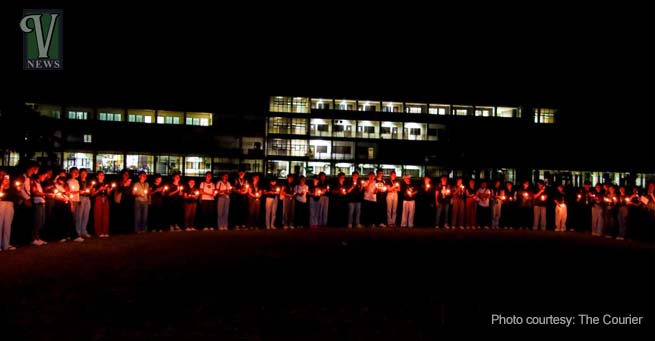
The observance concluded with a candle-lighting ceremony honoring journalists who lost their lives in pursuit of truth, followed by a symbolic effigy burning that called attention to issues of accountability and transparency.
As smoke slowly disappeared into the night sky, the message became clear: protecting press freedom is not only about defending journalists from censorship. It is about protecting the public’s right to know the truth, question authority, and participate meaningfully in society.
In an era where misinformation spreads faster than facts and fear silences critical voices, one question remains: if truth continues to be attacked, how long before people can no longer recognize it?
Photo courtesy: The Courier

