
 Jazmin Bonifacio
 Posted on September 1, 2026 at 4:16 pm

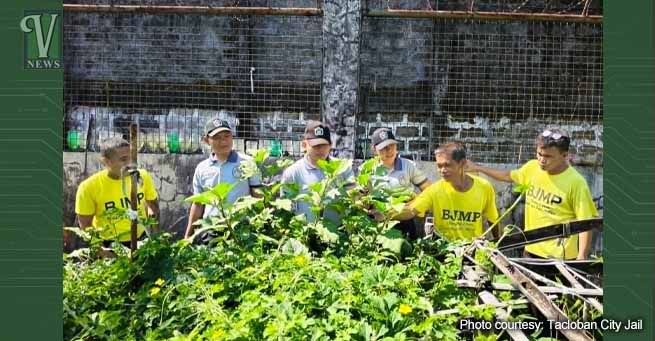
Tacloban City — Inside Tacloban City Jail, vegetables grow in a small patch of land surrounded by concrete.
Pechay, okra, ampalaya, eggplant, papaya and kamoteng kahoy are planted there. Tangkong, or water spinach, and pechay are harvested for food.
For Arjay Sembrero, 34, the garden has also given him a chance to learn something he did not know before.
He knew vegetables from the market.
He bought them and sold them.
Now, inside the jail, he is learning how to grow them.
“I am learning about the seeds … how they need to be buried properly to grow,” Sembrero said.
He is one of the Persons Deprived of Liberty (PDLs) taking part in the jail’s HAPAG, or Halinat Magtanim ng Gulay at Prutas, program.
He has learned about crop multiplication, as well as caring for plants and selling the crops they harvest.
Before, his role was to sell vegetables.
Now, he is learning what it takes to produce them.
“If I get out, I will really go into agriculture,” he said.
Sembrero sees farming as a possible livelihood when he leaves jail. He wants to help his elderly parents, support his child and, if he can, help pay for the child’s education.
“Laban la,” he said.
As long as there is life, there is hope.
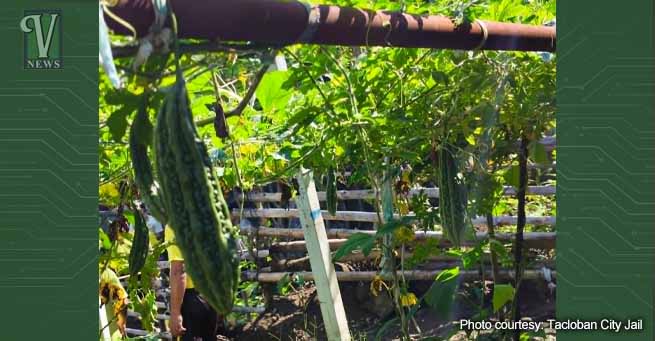
Making use of an empty space
About 100 to 200 square meters inside the jail have been used for the garden.
In a place where most of the surroundings are concrete, the small growing area stands out.
Portable hydroponics have also been introduced. The jail plans to expand the garden and put up a greenhouse where high-value crops such as lettuce can be grown.
The project started after Romelo Anade, chief of the Tacloban City Agriculture Office, noticed two things at the jail.
The meals served to PDLs did not always have much variety. At times, he recalled, food could be little more than soup.
At the same time, there were spaces inside the jail that were not being used.
Anade thought the space could be put to work.
“Why not use the space where the inmates can plant and grow crops, so they can become productive?”
With help from the City Agriculture Office, the jail started organic vegetable gardening and portable hydroponics.
The garden became a source of vegetables, but it also gave PDLs something to work on and learn.
What the garden produces
More than 500 PDLs are housed in the male dormitory of Tacloban City Jail, according to Jail Chief Inspector Benedicto Ramirez, the facility’s warden.
Each PDL has a daily food allocation of about P100.
The garden is not large enough to supply all of their needs, but its harvest provides an additional source of vegetables.
Depending on what is ready for harvest, the garden may produce about one kilogram of ampalaya, three kilograms of eggplant and two kilograms of papaya.
Some of the vegetables go to the jail kitchen.
Under the current arrangement, about half a kilogram of harvested vegetables may go to the kitchen and another half kilogram may be sold, depending on the available harvest.
The vegetables sold can bring in around P500, depending on what is harvested and sold.
Part of the produce may also be made available to PDL families to sell in the market. Families receive about one-fourth of the vegetables produced for this purpose.
The amounts are not large.
And the project was not started mainly to save money on the jail’s food budget.
Anade said the vegetables are mainly intended for the PDLs’ consumption and livelihood activities. The jail does not record direct savings from the produce, particularly because the project also involves assistance from other government agencies.
For the jail, the garden is also about teaching PDLs how to grow and handle crops.
Learning to plant
Agriculture workers from the City Agriculture Office visit the jail once a week.
They teach organic farming methods, including how to make organic fertilizers. Seeds are also provided so the PDLs can continue planting.
According to Anade, more than 500 PDLs are involved in the program, with planting continuing from one season to another.
The work starts with the basics: planting seeds, watering crops, cleaning the plots and looking after the plants until they are ready for harvest.
For Ramirez, those routines are important.
“Agriculture is life,” he said.
He believes the time a person spends in jail should not simply pass without purpose.
“The stay of a Person Deprived of Liberty should not be wasted or ‘sayang.’ We have to transform it into productive activity.”
For the men working in the garden, that means having something to do each day and learning a skill they may be able to use later.
Learning patience
Benjamin Soriano, 40, wakes up early to water the plants.
He calls it `magdidilig’.
Taking care of the garden has become part of his daily routine and a `libangan’, something to occupy his time.
He has also learned that plants cannot be hurried.
They have to be watered and cared for before they can be harvested.
Soriano shares some of what they grow with his father.
When he sends vegetables, he tells him that they came from the jail garden and that he was the one who planted them.
It is a small thing, but it gives Soriano something to share with his family while he is away from them.
From taking crops to growing them
For Anade, there is another reason the agricultural program matters.
Some PDLs, he said, were incarcerated for stealing agricultural products, including rice or humay.
Now they are being taught how those crops are produced.
They are learning the work that comes before the harvest.
Anade remembers an inmate who completed the Organic Agriculture Training.
During the graduation ceremony, the man received his certificate and told Anade:
“Sir, when I get out, I will plant because I am now a farmer.”
The statement stayed with Anade.
The training had given the man something he could use outside the jail and a way to see farming as work.
Thinking about life after jail
Sembrero is thinking about the same thing.
He used to earn from selling vegetables. Now he wants to learn how to grow them himself.
He hopes farming can become a “permanent” livelihood when he is released.
He wants to help his senior parents and provide for his child.
According to Ramirez, around 10 PDLs have expressed plans to continue farming after their release.
The jail hopes to connect them with the Department of Agriculture, agricultural cooperatives and Agrarian Reform Beneficiary Organizations, or ARBOs, so they can find ways to continue using what they learned.
The challenge is making sure the skills do not end when the jail training ends.
For someone like Sembrero, the goal is straightforward.
He wants to leave with something he can use.
Not just a certificate.
A skill.
A way to earn.
A way to provide for his family.
What the garden leaves behind
The garden cannot supply all the food needed by more than 500 PDLs in the male dormitory.
Its harvest is modest.
But it has become part of the daily life of the jail.
Vegetables go to the kitchen. Some are sold. Some reach PDL families. Seeds are planted again. Crops are tended and harvested.
And the men working there learn the process along the way.
Sembrero came into jail knowing how to sell vegetables.
Now he wants to grow them.
Soriano wakes early to water the plants and sends some of the harvest to his father.
Another PDL finished agricultural training and told Anade, “I am now a farmer.”
For the men inside Tacloban City Jail, the garden is a small piece of ground.
But it gives them something they can carry with them when they leave: the knowledge of how to plant, care for a crop and wait for a harvest.
And for some of them, that may be where the next chapter begins.


 Legal Battle Looms Over Cancabato Bay Causeway Project
  Fake bomb, shooting threats disrupt classes in Eastern Visayas
  Behind the Walls: How DSWD Helps Children in Conflict with the Law Start Again
  EDC to Triple Leyte Geothermal Capacity by 2030
  PCCI Eastern Visayas Calls for Stronger School Safety Rules After Tacloban Shooting
  The Extra Liter Paglaum Pupils Had to Carry