
 Jazmin Bonifacio
 Posted on August 29, 2026 at 3:29 am

Palo, Leyte — For children who get into trouble with the law, the Department of Social Welfare and Development (DSWD) in Eastern Visayas believes they should be given a chance to change and return home, rather than simply be locked up.
That is the purpose of the Regional Rehabilitation Center for Youth (RRCY) in Tanauan, Leyte, where children in conflict with the law (CICL) stay while undergoing rehabilitation.
DSWD-8 Director Grace Subong said minors involved in cases are given a suspended sentence and brought to the center instead of being placed in a regular jail.
It may be recalled that a 14-year-old student of San Jose National High School who was involved in a shooting incident was brought to the facility in Tanauan.
The RRCY has been caring for young people for more than four decades. It started operating in February 1981, when the DSWD rented a residential building on a 2,969-square-meter property in Barangay Sto. Niño, Tanauan, Leyte.
The property is along the Maharlika Highway, about 22 kilometers from Tacloban City.
The DSWD purchased the property on July 15, 1985. The residential building was later repaired, and additional structures were built as the center expanded.
The facility can now accommodate up to 50 children. More than 30 are currently staying there, Subong said.
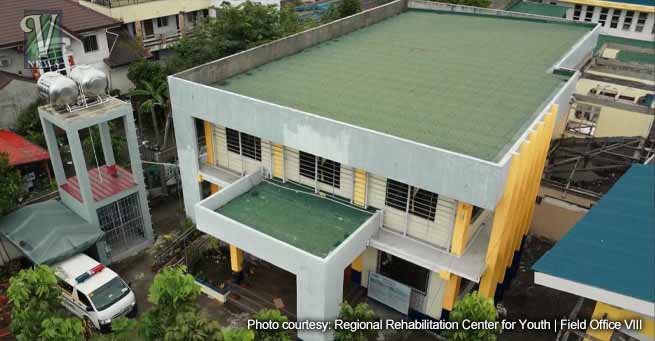
Walking into the center does not feel like entering a regular jail. It is designed more like a house and does not have barbed wire or electric fences.
But the children still cannot simply walk out whenever they want.
Their days follow a routine. They cook their food, wash dishes, do their laundry and take care of other chores around the center.
Subong said these simple tasks are part of the rehabilitation. They teach the children responsibility and help them prepare for the time when they return to their families.
The children are not left to deal with their problems on their own. Social workers, house parents, nurses, psychometricians and manpower development officers work with them.
Each child undergoes an assessment and is given an intervention plan based on his or her needs. Psychological assessments are also conducted to help the team understand what may have happened in the child’s life and what could have influenced the child’s behavior.
Subong said staff members pay close attention to changes in the children’s behavior.
Even something as simple as refusing to bathe or take care of personal hygiene can be a warning sign, she said, because it may show that a child is struggling and needs more help.
The DSWD also brings in outside experts, including consultants from Ateneo and specialists such as Dr. Alampay, to help assess the children and guide their rehabilitation.
A child may stay at the center for about a year, but Subong said there is no set length of stay. It depends on how the child responds to the program and how much progress he or she makes.
The center has also tightened security following previous incidents involving children who left the facility.
There is now stronger perimeter fencing and security guards who patrol around the clock. Two police officers are stationed inside the center, while another stays at the gate.
Still, Subong said the DSWD does not want the community to see the facility simply as a place where children are kept behind fences.
The agency has held meetings with barangay officials and nearby residents to explain the Juvenile Justice and Welfare Act and the work being done at the center.
For Subong, community support matters because these children will eventually go back to their families and neighborhoods.
The work at the RRCY, she said, is not simply about keeping children away from the community. It is about helping them understand what went wrong, deal with the problems they face and make better choices when they return home.
When the DSWD believes a child is ready, it makes a recommendation to the court.
The final decision on the child’s release, however, remains with the court.
For the children staying at the RRCY, the hope is simple: finish the program, return home and have another chance to move forward.
Photo courtesy: Regional Rehabilitation Center for Youth | Field Office VIII
Photo Caption: The Regional Rehabilitation Center for Youth in Barangay Sto. Niño, Tanauan, Leyte, has been helping young people in conflict with the law for more than 40 years. The center, which started in 1981, can accommodate up to 50 children and currently has more than 30 residents.


 EDC to Triple Leyte Geothermal Capacity by 2030
  PCCI Eastern Visayas Calls for Stronger School Safety Rules After Tacloban Shooting
  The Extra Liter Paglaum Pupils Had to Carry
  Two Eastern Visayas schools to test digital learning system for Grade 2 pupils
  300 Tacloban Seniors Receive Up to P100,000 in Aid
  Libagon Suspends Classes as Engineers Check Schools After Quake