

 Gina Dean
 Posted on October 16, 2026 at 4:36 am

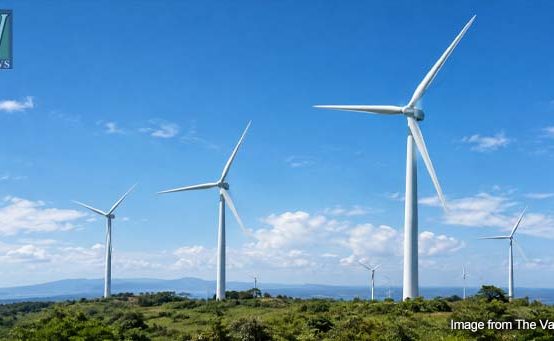
Calbayog City, Philippines — A P20-billion renewable energy project spearheaded by a Singaporean-based Vena Energy Corporation through its project implementer and subsidiary, Gemini Wind Energy Corporation (GWEC) appears poised to move forward, following critical modifications to its site proposal.
During a public hearing at the Calbayog City Convention Center on September 30, Samar Governor Sharee Ann Tan presented updated project plans to local stakeholders, signaling a major turning point for the controversial development.
Out of 37 wind turbines, 20 will move forward, while 17 were disapproved or put on hold after issues were identified because they are situated in ecologically sensitive areas.
New Scrutiny Surfaces Over Amended Wind Farm Proposal
Despite official assurances surrounding the amended application for the wind power project, independent environmental experts have raised immediate flags over the revised turbine coordinates, warning that the threat to Calbayog City’s key ecological landmarks remains unmitigated.
A closer technical review of the developer’s updated layout reveals that several proposed wind turbine generators remain dangerously proximate to the boundaries of the Calbayog Pan-as Hayiban Protected Landscape (CPHPL).
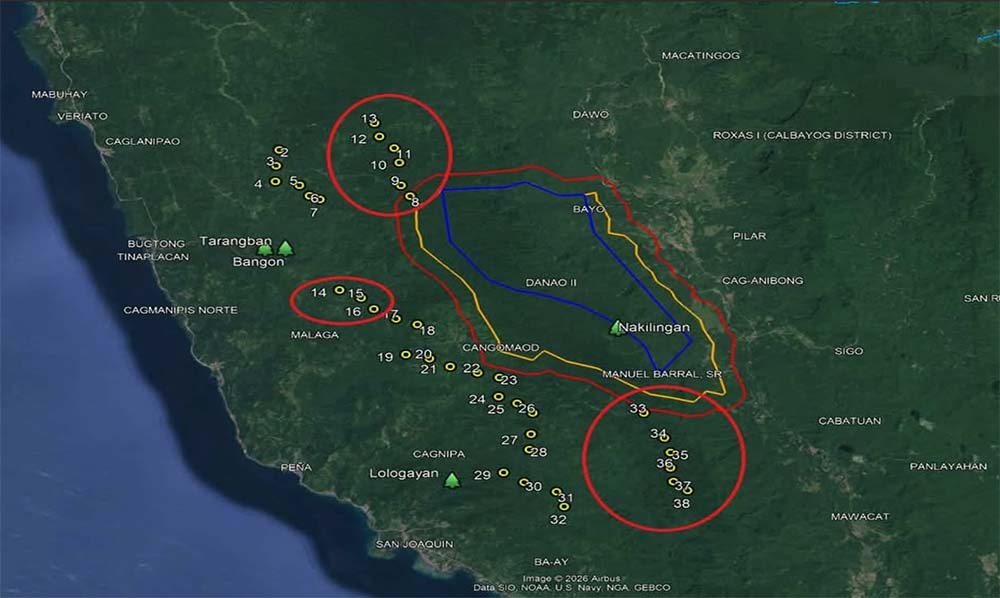
Most alarming among the experts’ findings is the designated placement of turbine installations directly above Tarangban Falls—one of the region’s premier natural water features and a vital eco-tourism asset for Barangay Tinaplacan and surrounding communities.
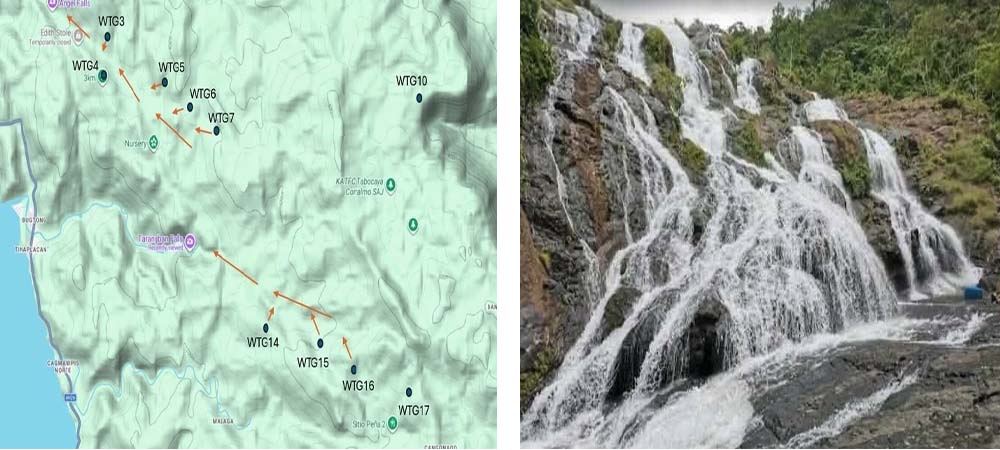
The discovery has reignited calls from civic advocates and technical specialists for an independent spatial audit of the amended application, emphasizing that redrawing map lines on paper offers little defense against real-world environmental degradation.
According to Professor Phil Harold Mercurio, Executive Director of Samar Island Heritage Inc, the ongoing protests is focused specifically on Clusters 3, 4, and 5, spanning 15 to 17 proposed wind turbine generator sites. He said that placing heavy machinery and concrete foundations at these high-elevation entry points will carve open untouched forest corridors.
“The transfer of wind turbines in different locations is very clever.” Mercurio said.
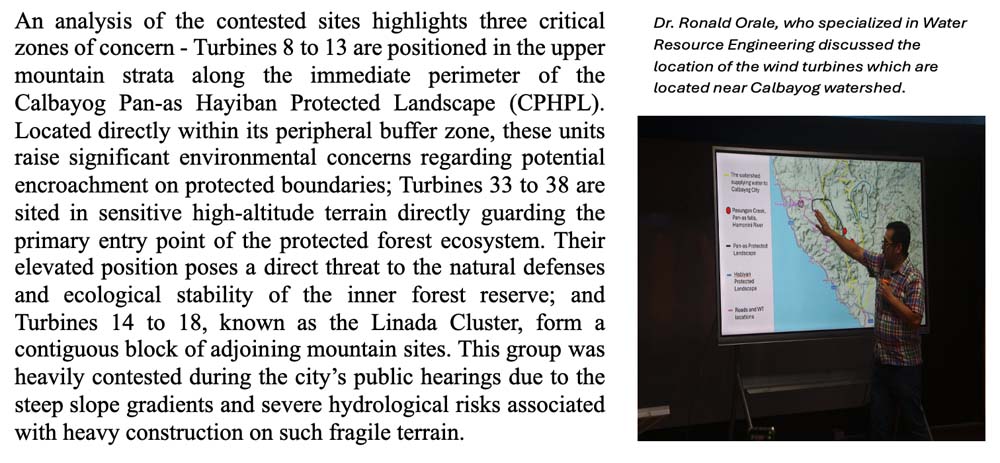
He argued that clearing access roads and excavating ridgelines for Clusters 3, 4, and 5 will create unintended access routes into once-impenetrable forest cover, inviting illegal logging, fragmenting habitats for endemic wildlife, and triggering severe soil erosion above vital watershed catchment basins.
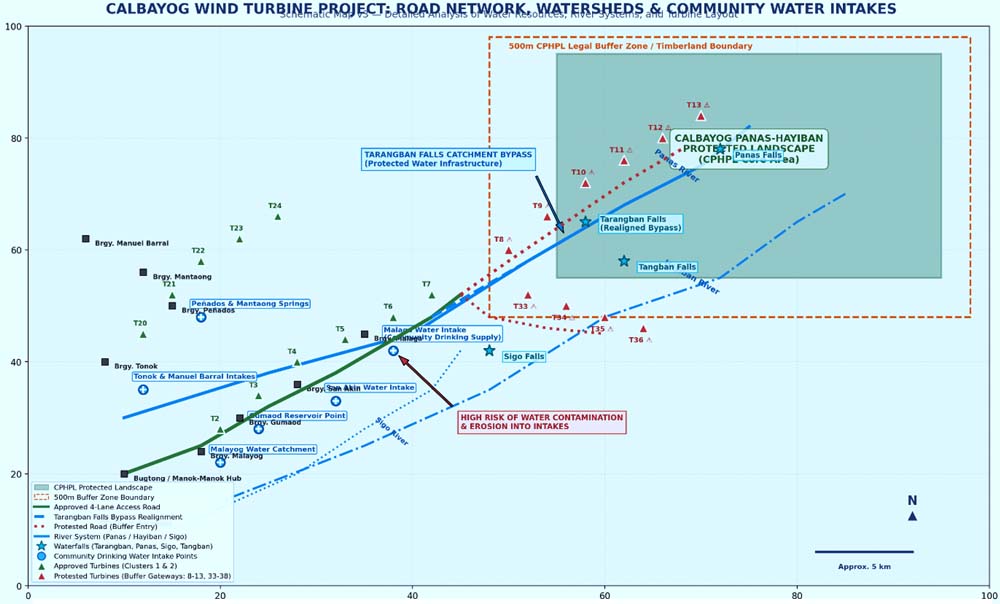
Professor Mercurio clarified that his position along with other environmental advocates is not an absolute rejection of renewable energy. In fact, the TEAC-SAMSEA (Tinambacan Environmental Advocates Coalition – Samar Multi-Sectoral Environment Advocates) has formally signaled agreement with the construction of Cluster 1 (Turbines 2 to 7) and Cluster 2 (Turbines 20 to 32), recognizing that these installations are situated at safer distances from the protected forest boundary where environmental degradation can be minimized.
The selective opposition leaves the project implementer facing a clear ultimatum: relocate the high-risk mountain clusters or face continued civic resistance over the protection of Calbayog’s primary water source.
“If you sum it all up, the destruction far outweighs the benefits. And when we speak of benefits, the ones who profit the most are the foreign capitalists. Although there are revenues from wind turbines, taxes, and corporate social responsibility programs, these are just tiny crumbs they share with the community.
If you weigh the cost against the benefit, the cost is much higher than the benefit. Will our electric bills even go down? Following the latest developments, instead of decreasing, electricity bills have actually gone up. So what reason is there for Calbayognons or Samarnons to celebrate?
If we place wind turbines in the right locations, our years of conservation efforts won’t go to waste. Wind turbines are very welcome—provided they are put in the proper place”, Mercurio stressed.
Samar Governor Sharee Ann Tan has finally agreed to temporarily halt the installation of 17 wind turbine generators (WTGs) slated for eco-sensitive and heavily contested areas, particularly near Tarangban Falls and within the vicinity of the Calbayog Pan-as Hayiban Protected Landscape.
The decision reflects a delicate balancing act between renewable energy goals and ecological preservation, as local leaders and environmental regulators clarify that prior approvals do not grant automatic authorization to construct in high-risk zones.
Clearance vs. Construction: The DENR Mandate
According to Eastern Visayas Assistant Regional Director Angelito Villanueva, the suspension aligns with the conditions of the Environmental Compliance Certificate (ECC) previously issued by the Department of Environment and Natural Resources (DENR) Region 8. He emphasized that an ECC serves as a regulatory baseline rather than a blanket clearance to build in environmentally fragile locations without ongoing compliance and site-specific reviews.
The temporary halt ensures that high-risk turbine placements near vital headwaters and protected forest boundaries undergo rigorous technical examination before any ground is broken.
Before Turbine Pause, P10M CSR Pact Sparked Fierce Community Backlash
Before authorities ordered a temporary halt on the 17 contested wind turbines, a financial agreement had already sealed a pact between local officials and the project developer—triggering widespread public outrage across host communities.
On May 25, the Provincial Government of Samar signed a Memorandum of Agreement (MOA) with Vena Energy Corporation covering Corporate Social Responsibility (CSR) initiatives across 13 designated host barangays: Baay, Manuel Barral Sr., Bayo, Bugtong, Cag-anibong, Caglanipao Sur, Cagmanipis Norte, Cagmanipis Sur, Danao II, Dawo, Malaga, Pilar, and San Joaquin.


 Who Holds the Reins? Calbayog Pushed to the Margins in a 20-Billion Renewable Energy Venture (3/3)
  Catbalogan City Declared Peaceful and Stable
  Drug Suspect Arrested, 7 Shabu Sachets Seized in Catbalogan
  Calbayog LGU, SAMELCO I Discuss Rising Power Rates
  Catbalogan Walang Gutom Kitchen to Serve 400 Meals Daily Starting October