
 Gina Dean
 Posted on Mar. 3, 2026 at 8:43 am

The revelation that the Calbayog Pan-as Hayiban Protected Landscape (CPHPL) is already 20% developed is a flashing red light for the Sangguniang Panlungsod. With over 1,013 hectares already impacted by human activity, the remaining “climax vegetation” of dipterocarp forests—those magnificent giant trees—is not just a park; it is a fortress under siege.
The Myth of the “Boundary Line”
Vena Corporation’s move to place all 37 turbines outside the CPHPL is a tactical retreat, but it ignores the biological reality of the 16 surrounding barangays. From Pilar to Capacuhan, these communities form a living buffer. When 10% of a barangay like Danao II or Cag-anibong sits inside the protected area while the rest sits outside, the “border” is invisible to the ecosystem.
Construction outside the line still affects what is inside. The steep and rolling terrain described in the ecological profile means that any soil disturbed by turbine foundations in the “unprotected” parts of these 16 barangays will inevitably slide downhill into the protected watersheds during Samar’s heavy rains.
Why the CPHPL Cannot Afford More Pressure
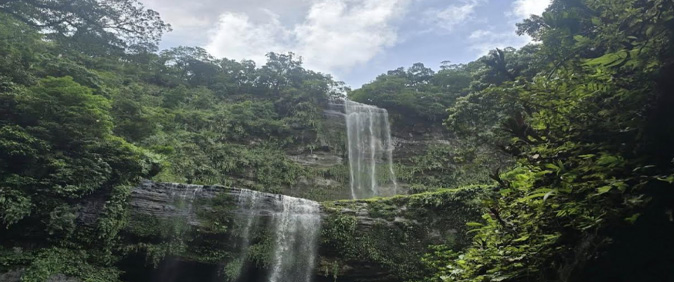
The data highlights three specific reasons why the Save Calbayog Rivers Foundation Inc. is right to be protective of Tarangban and Bugtong Falls:
The 20% Threshold: If 20% of the park is already developed, the ecosystem’s “resiliency” is lowered. Adding 37 massive industrial structures right on its doorstep could be the tipping point that degrades the remaining 80% of natural forest.
The “Sponge” Effect: Dipterocarp forests act as a natural sponge. The “giant trees” mentioned are the primary reason Calbayog has a steady water supply. Replacing these—or their surrounding vegetation—with steel and concrete foundations disrupts the natural flow of water to the 16 barangays.
Human Impact: With Sitio Peǹa II located entirely within the protected area, the residents are the first line of defense—and the first victims if the water table is disrupted.
A Call for a “Hydrological Buffer Zone”
The City Council should not just look at the CPHPL map. They must look at the hydrological map. If Tarangban and Bugtong Falls are potential water sources, they must be treated as part of the protected area’s “functional zone,” regardless of where the legal line is drawn.
Transparency as the Ultimate Safeguard
The road to “green energy” must not be paved with broken promises and backroom deals. Vena Corporation must honor its commitment to radical transparency, ensuring that every step of the legal process—most notably the Certificate of No Objection—is preceded by genuine, inclusive barangay assemblies.
We cannot afford a repeat of the past, where the DENR-8 blindsided the community by issuing an Environmental Compliance Certificate (ECC) without prior notice or public consultation. An ECC is meant to be a seal of safety, not a surprise attack on local sovereignty.
If the corporation continues to operate in the shadows, bypassed by the very people it claims to serve, the cost will be measured in more than just signatures. The community risks waking up to a nightmare: ancient dipterocarps felled, mountain slopes surrendering to floods, and the life-giving veins of the Calbayog watershed—the community’s primary water supply—run dry. True progress is not just about the power generated by turbines; it is about the power of the people to protect their land. No assembly, no consent. No transparency, no project.


 Calbayog activates disaster preparations ahead of Super Typhoon ‘Bavi’
  Calbayog Vice Mayor Checks Hotels, Pushes Plan to Turn City into Region 8’s Mice Hub
  The Price of a Spectator Seat: Calbayog’s Sovereignty in the Shadow of Wind Turbines
  Mayor Vows Stoppage of Calbayog Wind Project if a Single Life is Lost
  Man arrested in Calbayog Drug Operation