

 Gina Dean
 Posted on October 16, 2026 at 5:16 am

Local officials, environmental advocates, and academic experts of Calbayog City, Samar are raising severe concerns over a massive renewable energy venture led by Vena Energy, questioning local autonomy, ecological risks, and project routing after the Provincial Government of Samar assumed the role of direct contracting authority, leaving Calbayog City to sign the deal merely as a witness.
While the project promises job creation in turbine construction zones and financial assistance for barangay-level infrastructure and programs, local observers warn that reducing the city to a passive bystander sets a troubling precedent for local governance and environmental safety.
Pushed Back by Environmental Advocates
The developer’s current project plan is already a revised submission. The previous proposal by Vena Energy was heavily challenged by environmental advocates, forcing the corporation to submit a new project outline.
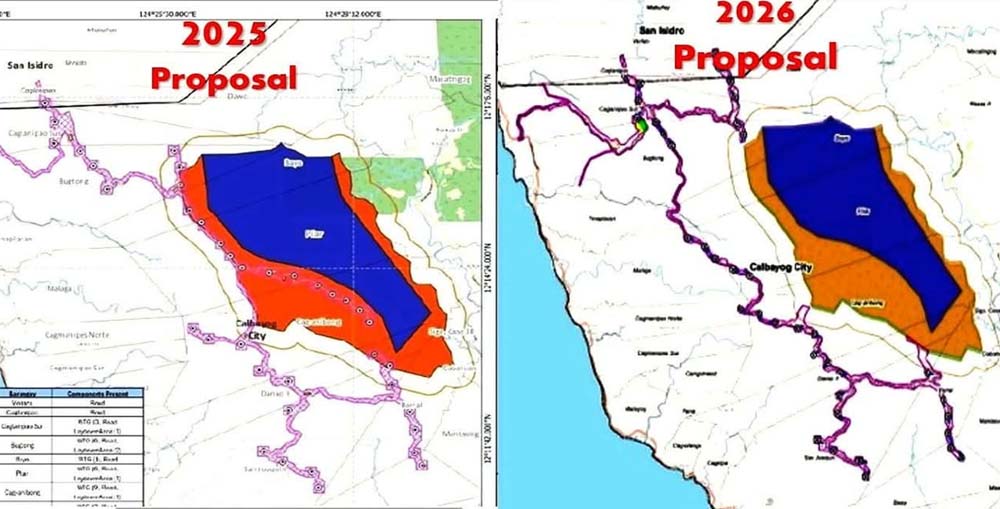
The orange area is the multi-use buffer zone, encompasses the surrounding outer perimeter and lower peripheral corridors near established communities like San Isidro, Caglanipao, Bugtong, and Manok-Manok. Designed for regulated development, this zone was identified for the installation of turbines and access tracks were plotted.
However, the revised proposal continues to draw intense scrutiny. During a recent public hearing, advocates and experts raised alarm over 17 wind turbine generators (WTGs) that remain situated within “critical areas”—prompting officials to officially put those installations on hold.
The suspended turbines span several host communities, including WTGs 8 and 9 in Brgy. Bugtong; WTGs 10–13 in Brgy. Dawo; WTGs 14–16 in Brgy. Malaga; WTGs 17 and 18 in Brgy. Pilar; WTG 33 in Brgy. San Joaquin; WTGs 34–36 in Brgy. Barral; and WTGs 37 and 38 in Brgy. Baay.
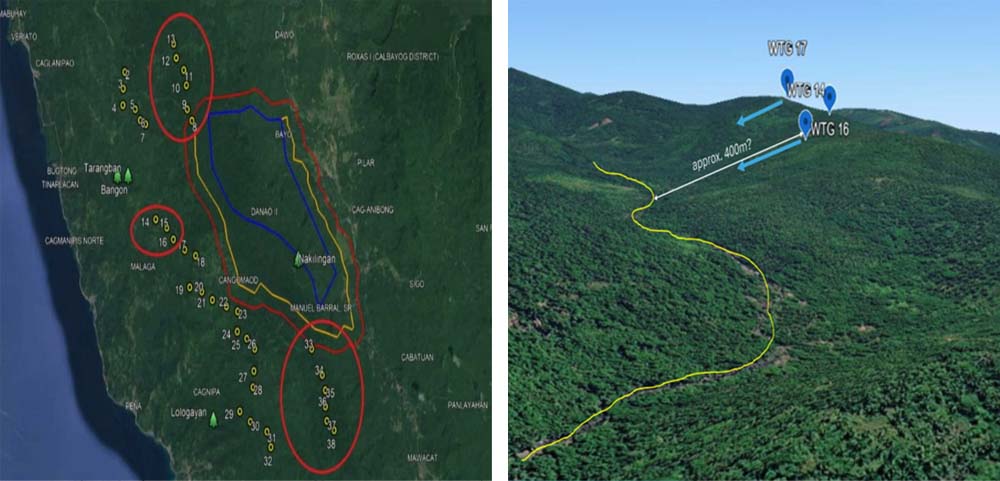
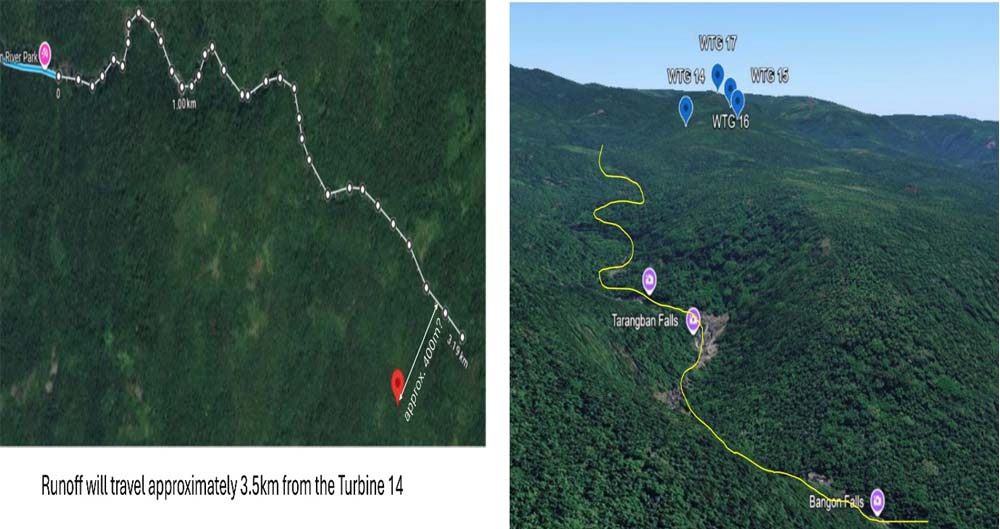
Corroborating these environmental risks, Northwest Samar State University professor and environmental planner Novlloyd Celeste warned that these critical zones extend directly into the project’s proposed road network, posing severe hazards to the region’s steep terrain and forest canopy.
Top-Down Approach Sparks Friction
The controversy is compounded by the project’s initial classification as an initiative of “national significance.” By negotiating directly at regional and national levels, Vena Energy Corporation did not coordinate with the City Planning and Development Office (CPDO) prior to conceptualizing the project, effectively bypassing standard city planning channels during early negotiations.
Under the current arrangement, the Provincial Government of Samar acts as the primary contracting party with the developer, while Calbayog City’s local government unit (LGU) was relegated to a secondary signatory position.
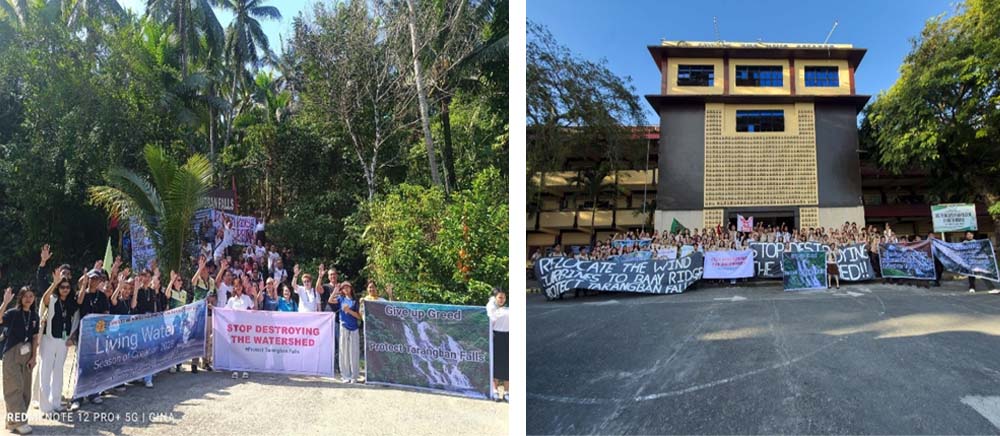
Critical local voices argue that because turbine installations directly impact Calbayog’s land, local environment, and daily livelihoods—ranging from heavy machinery traffic and land disturbance to long-term ecological changes—decisions must pass through the city’s administrative channels.
Lack of Technical Blueprints and Mapping Concerns
Local planning officials emphasized that the city cannot grant clearance or issue permits blindly without thorough technical scrutiny and documentation.
According to City Planning and Development Coordinator (CPDC) Reo Marquez, the developer failed to submit complete technical plans, exact spatial maps, or detailed road alignments to the Calbayog City Engineer’s Office or the CPDO for local zoning review. Without these critical blueprints, local authorities remain in the dark regarding the precise physical footprint of the project.
Marquez voiced concern that while developers verbally claim they will adjust or relocate contested turbine towers, they have yet to present complete spatial maps or road network designs to the city for actual on-ground verification.
He highlighted that even if turbine towers are shifted slightly outside strict protection lines, the access roads required to transport heavy equipment could still cut through steep, fragile forest slopes unless alternative routes or offshore options are used.
Technical Working Group Demanded Amid Unclear Timelines
To address these gaps, the city has insisted on forming a Technical Working Group (TWG)—comprising the City Mayor, City Engineer, CPDC, other experts to independently evaluate the project’s spatial maps, road routes, hydrological impacts, and environmental trade-offs before any local clearance is issued.
Currently, no specific compliance deadline or fixed timeline has been established for Vena Energy. Marquez noted that the CPDO and the city’s technical team are actively waiting for the company to formally submit their complete technical reports, exact spatial maps, and road network routing presentations.
Demands for Local Autonomy and Oversight
Local governance advocates stress that while green energy investments and private capital are crucial for sustainable development, economic progress should not override local autonomy and democratic accountability.
City officials, academic experts, and community members are calling on Vena Energy and the Provincial Government of Samar to grant Calbayog City full oversight powers. Local leaders maintain that true partnership requires transparency, local consent, strict adherence to municipal zoning regulations, and an active seat at the negotiating table—ensuring Calbayog is an empowered partner rather than a witness on a signature page.


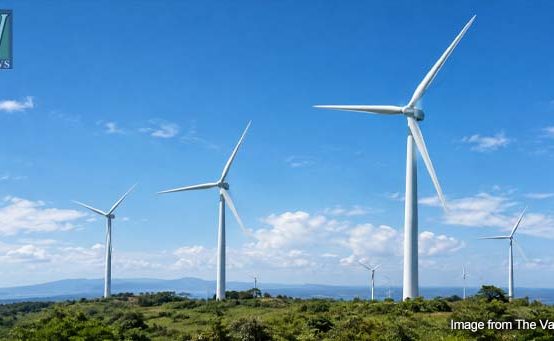 The Unsettling Silence: Trading Samar’s Natural Treasures for Wind Turbines (2/3)
  Catbalogan City Declared Peaceful and Stable
  Drug Suspect Arrested, 7 Shabu Sachets Seized in Catbalogan
  Calbayog LGU, SAMELCO I Discuss Rising Power Rates
  Catbalogan Walang Gutom Kitchen to Serve 400 Meals Daily Starting October