
 Jazmin Bonifacio
 Posted on August 13, 2026 at 2:08 pm

When the Water Falls, What Happens to Them?
Calbayog City, Samar — Jimmy Baleros knows the stream in Barangay Tinaplacan well. He sees it almost every day. People in the community use the water for washing and other household needs. For Baleros, the stream is also tied to the work that helps him earn a living.
He works as a tour guide for visitors going to Tarangban Falls. For every group he accompanies, he earns about P300.
It is not a large amount of money. But when tourists do not come every day, each group matters.
Baleros is not alone.
Habal-habal drivers bring visitors from the main road to the jump-off point. On a good day, a driver can make around P500, depending on the number of trips.
A single visit to Tarangban can therefore put money into several pockets, the motorcycle driver, the tour guide and other people in the community who earn from visitors.
For them, Tarangban is more than a swimming spot or a place to take pictures.
It is work.
So when people begin talking about wind turbines and possible changes to the forests around Calbayog, the conversation does not feel far away to Baleros.
He has a simple concern: What happens to the people who depend on the falls if something happens to the forest and the water?
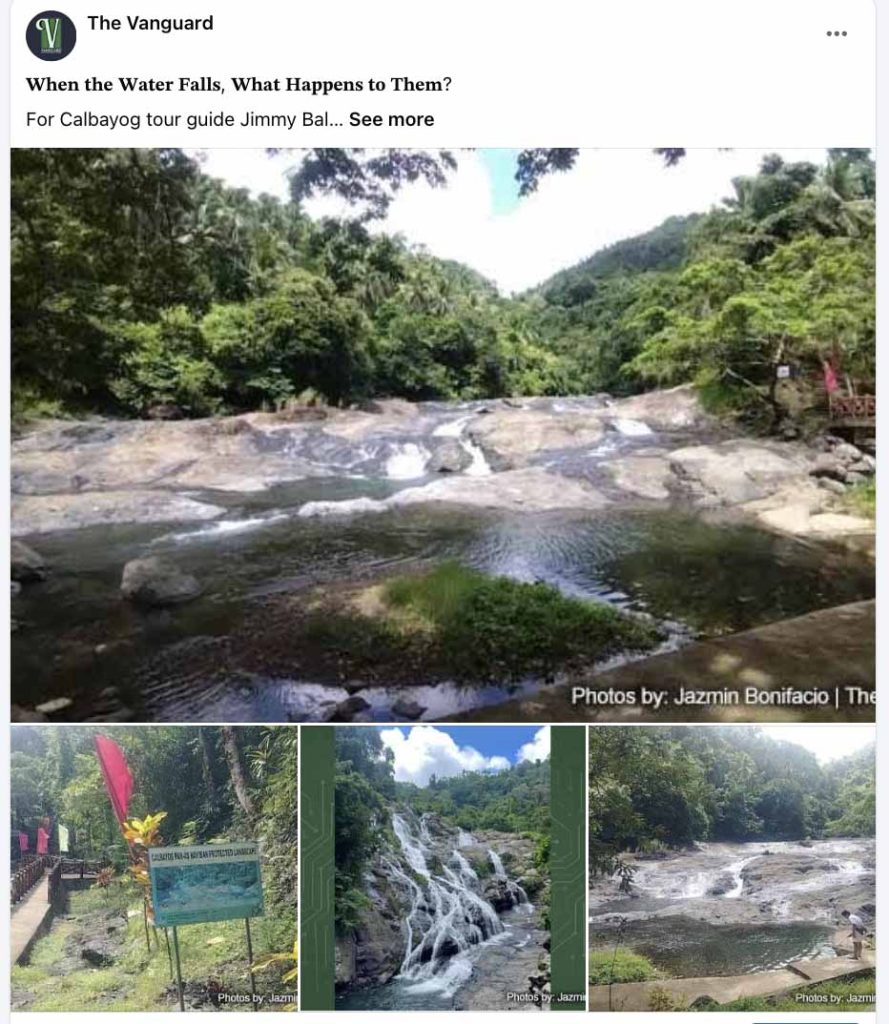
The Road to Tarangban
The trip to Tarangban begins on the road in Barangay Tinaplacan. Visitors can take a habal-habal to the jump-off point. From there, they have to walk.
The trail takes about 30 minutes.
As the walk continues, the sounds of motorcycles and other vehicles disappear. The surroundings become quieter. Trees line the path, and the sound of running water slowly becomes louder.
Then the falls come into view.
Tarangban is not one tall waterfall dropping from a single cliff. Water moves over and around large rocks, forming a series of cascades along the slope.
The water is cold and clear. Visitors sit on the rocks, wade through the pools or simply stay close to the rushing water.
It is easy to see why people come.
Calbayog has long been known as the “City of Waterfalls.” About 60 percent of the city’s land area consists of mountain ranges, with elevations of roughly 300 to 700 meters. The mountains hold forests, streams and waterways that are part of the landscape and part of the city’s identity.
Tarangban is one of those places.
For Baleros, however, the falls mean something more practical.
When tourists come, he has work.
A City of Waterfalls
Tarangban is only one of the waterfalls in Calbayog.
The city tourism office has validated 22 waterfalls, while an earlier study by Northwest Samar State University identified as many as 35, although some still need further validation.
In Tinaplacan alone are Larik, Bangon, Tarangban, Baru-baluto, Madalunot and Bugtong, among others.
Bangon and Tarangban are among the more accessible and popular falls in the area.
Their water comes from the landscape above them.
Rain falls on the mountains and moves through streams and other waterways. Forests and soil help absorb and hold some of that water before it makes its way downhill.
Eventually, some of it reaches the waterfalls.
Professor Harold Mercurio of Northwest Samar State University and executive director of the Samar Island Heritage Center Inc. describes the forest as a `natural sponge.’
It absorbs water, slows its movement and helps maintain the recharge areas that feed streams, waterfalls and other water sources.
For people in Tinaplacan, this relationship is easy to see.
They do not need a map to know where the water comes from.
They live beside it.
The Falls Put Food on the Table
For Baleros, the future of Tarangban is tied to whether visitors will continue coming.
If the waterfall remains accessible and the water keeps flowing, guides can continue working.
Habal-habal drivers can continue taking passengers.
Small businesses and other residents can continue earning from tourism.
But if something changes in the watershed and the waterfall is affected, the loss may not stop at the water.
It could reach people’s pockets.
This is one reason residents and environmental groups have been watching the proposed wind-energy project in Calbayog.
The project involves 37 wind turbines. Environmental groups have raised concerns about turbines and the infrastructure needed to support them, including roads and foundations, particularly in areas connected to the watershed.
For residents, the concern is what development might mean for the forest.
More roads and construction can mean clearing trees and disturbing the surrounding landscape.
And that brings the question back to the water.
If the forest is disturbed, will the water still flow the same way?
And if the water changes, will tourists still come?
For Baleros, there is no complicated answer to what that could mean.
It could mean fewer groups.
Fewer groups could mean less income.
What City Hall Says
The Calbayog City Government has made clear that it is not against renewable energy itself.
Its concern is the location of the proposed turbines.
Mayor Raymund “Monmon” Uy has said the city is not completely opposed to the wind-energy project. The city has instead objected to turbines planned within the Calbayog Pan-as Hayiban Protected Landscape (CPHPL), which includes a major watershed and serves as a primary source of water for Calbayog.
In November 2025, Uy said the city was opposing 13 turbines planned within the primary watershed. The Sangguniang Panlungsod also passed a resolution opposing the proposed installations in parts of the 5,067.93-hectare protected landscape and called for the return of the area’s former `strict protection zone’ designation.
The city’s position is that wind energy can be pursued, but not if doing so puts an important water source at risk.
That position became more visible in February 2026.
Vena Corporation confirmed the cancellation of five turbines originally planned inside the CPHPL. The company’s updated technical layout showed the affected turbines relocated outside the protected landscape.
The city government welcomed the decision.
Uy said renewable-energy projects should continue to be guided by environmental responsibility, scientific studies and long-term protection of natural resources.
Experts who joined a city council session also called for an Environmental Impact Assessment, hydrological mapping and biodiversity studies before development moves forward.
For City Hall, the concern is not whether Calbayog should have renewable energy.
It is where the turbines should go.
The city wants the investment and cleaner energy that the project could bring.
At the same time, it wants to protect the watershed that supplies its people with water.
The Forest Above the Falls
Mercurio’s concern starts higher up the mountain.
The forest does more than make the area green.
It helps hold soil and water. It can reduce runoff and help keep streams flowing.
Calbayog has also experienced landslides and flash floods, including in parts of Tinambacan and Oquendo.
That makes the condition of the upland forests important, especially as communities deal with changing weather and stronger rainfall events.
Mercurio wants more studies before sensitive areas are developed.
He is calling for biodiversity assessments, water-source studies and mapping of the resources in the area.
He does not describe renewable energy as the enemy.
His concern is what happens when development moves into places that perform important environmental functions.
“Once nature is destroyed, it is gone forever,’”Mercurio says.
In Tinaplacan, that warning is easier to understand when put in everyday terms.
A damaged forest may be a line on a map.
For Baleros, it could mean less water.
It could mean fewer visitors.
It could mean losing the P300 he earns from a group of tourists.
A Student Watching the Mountains
Dangilo Rontos, a student at Northwest Samar State University, looks at the issue from another distance.
From the university, the mountains can seem far away.
But they are part of the Calbayog Pan-as Hayiban Protected Landscape, an area environmental advocates consider important for water, biodiversity and protection from severe weather.
Rontos worries about what large-scale development could mean for the protected landscape.
He does not believe protecting the mountains means stopping every kind of development.
For him, it means knowing what can be built, where it can be built and what the consequences might be.
The city is already dealing with heat, floods and landslides.
If forested areas are disturbed without understanding what could happen afterward, communities may be left dealing with problems that could have been avoided.
For Rontos, the mountains are not just part of the view.
They are part of what his generation will inherit.
The Need for Energy
Calbayog needs energy.
Like other cities, it is also looking for cleaner sources of power.
That is where the proposed wind project comes in.
Wind turbines can produce electricity without burning fossil fuels, and the project could bring investment to the area.
But renewable energy still needs land.
Turbines need foundations. Roads have to be built. Workers and equipment have to reach the sites.
In a forested and mountainous area, those activities can have effects beyond the construction site.
That is why residents and environmental advocates want to know more before development continues.
Where are the water sources?
Where does rainwater collect and recharge the streams?
What plants and animals live in the area?
How much forest will have to be cleared?
What happens to communities below if the watershed is disturbed?
For Mercurio, these questions need answers before construction, not after.
The city government appears to share that concern, at least where protected areas and critical water sources are involved.
The challenge is finding a way to pursue new energy without damaging resources that people already depend on.
Small Amounts, Real Livelihoods
For Rontos, the numbers involved in the tourism around Tarangban may look small.
Baleros earns P300 from a group.
A habal-habal driver can make around P500 in a day.
But those amounts pay for food, transportation and other daily needs.
They are not abstract figures.
They are money earned by people living near the falls.
And that money comes from the landscape.
The waterfall brings tourists.
The tourists create work.
The work provides income.
That is why people like Baleros do not see the wind project only as a question about electricity.
They see it in terms of what could happen to the place where they earn their living.
If the Water Changes
The connection between the forest and the people of Tinaplacan can be easy to miss.
The forest is up in the mountains.
The waterfall is farther down.
The guide waits at the trail.
The habal-habal driver waits near the road.
But they are all connected by the same water.
Rain falls on the mountain.
The forest holds it.
Streams carry it downhill.
The water reaches the falls.
Visitors come to see it.
And people in the community earn from those visitors.
That is the chain Baleros worries about.
Calbayog can continue pursuing renewable energy. The city government has already said it is not against the technology itself.
But the location matters.
The five turbines removed from the CPHPL show that the project can still change as environmental concerns are considered.
For the people around Tarangban, however, the larger question remains.
Will the forest stay?
Will the water keep flowing?
Will the tourists keep coming?
Baleros does not need to talk about megawatts or energy targets to explain what is at stake.
He can point to the stream.
He can point to the trail.
He can point to the waterfall.
And he can tell you what happens when visitors arrive.
He works.
For him, Tarangban is not an environmental issue discussed in a meeting room.
It is a place where he earns money.
It is a place his neighbors depend on.
It is the water they see every day.
And if that water changes, the change will not stay in the mountains.
It will reach the people below.
Because for those who live by the falls, the water is not just part of the landscape. It is part of their lives.
Photos by: Jazmin Bonifacio | The Vanguard


 Calbayog LGU, SAMELCO I Discuss Rising Power Rates
  Catbalogan Walang Gutom Kitchen to Serve 400 Meals Daily Starting October
  Five Calbayognon Women Take Home Crowns in Hadang Festival 2026
  Construction worker shot in Catbalogan
  Police Step Up Patrols After Gunfire in Catbalogan
  Rank 8 Drug Target Nabbed in Zumarraga Buy-Bust