
 Jazmin Bonifacio & Christian Ray Torres
Posted on October 22, 2026 at 02:05 PM

THE MARITIME CORRIDOR
Drugs, the Sea, and Eastern Visayas’ Place in the Trafficking Route
PART 1 – The Highway at Sea
Sixty-two-year-old fisherman Samuel Dalimpapas of Barangay Tangbo was fishing off the coast of Arteche at around 3:30 p.m. when he spotted packages floating in the water.
There were 20 bricks of cocaine. The packages weighed a total of 21.19 kilograms and were later valued by authorities at P111.85 million.
The fisherman turned them over to authorities.
The discovery in March 2024 was not an isolated incident. For years, drugs have surfaced along the Pacific coast of Samar and Northern Samar. Cocaine was recovered in Eastern Samar in 2009 and 2010, and again in Guiuan in 2018. In 2019, shabu was found along the coast of Biri Island in Northern Samar.
These recurring discoveries point to a vulnerability that is difficult to address: Eastern Visayas is connected to the rest of the country through a network of roads, ports, ferry routes, and coastal waters.
The same network that moves people and goods across the country can also be exploited to transport illegal drugs.
Eastern Visayas is composed of six provinces: Biliran, Eastern Samar, Leyte, Northern Samar, Samar, and Southern Leyte. The region had a population of 4,625,929 in 2024, according to the Philippine Statistics Authority (PSA).
Its location makes it an important link between Luzon, the Visayas, and Mindanao.
From Luzon, vehicles and passengers cross the San Bernardino Strait to Allen, Northern Samar. From there, the Pan-Philippine Highway runs through Samar and across the San Juanico Bridge into Leyte. Ferry and roll-on/roll-off (RoRo) routes then connect the region to Cebu and Mindanao.
For most people, this is simply how goods and passengers move between islands.
For drug traffickers, authorities have found, the same network can also serve as a route.
A SHABU SHIPMENT BOUND FOR CEBU
One of the clearest examples came in October 2019.
Police seized approximately 88.49 kilograms of shabu in Barangay Tagnao, Gandara, Samar. Authorities valued the shipment at around P600 million.
The size of the shipment was significant, but investigators were also interested in its intended destination.
Police said the shipment was bound for Cebu rather than the local market in Samar.
Investigators said the suspects had previously transported shabu from Manila to Cebu through Samar.
The case showed how Eastern Visayas could be used as a passageway between larger markets.
The drugs did not have to be intended for Samar to pass through the province.
That distinction is important when examining the region’s drug seizures. A large seizure does not necessarily indicate an equally large local market. It may mean that a shipment was intercepted while passing through the region.
ALLEN: A ROUTE FROM LUZON TO MINDANAO
The same pattern emerged again in Northern Samar.
In January 2023, authorities intercepted approximately 10 kilograms of shabu packaged in Chinese tea wrappers in Barangay Jubasan, Allen, Northern Samar, near the Port of Allen. The drugs were valued at about P69 million.
According to the Philippine Drug Enforcement Agency (PDEA), the shipment had been transported from Luzon and was headed for Mindanao.
PDEA described the region’s nautical highway as a transshipment route for illegal drugs.
Allen is a natural point of interest for law enforcement because of its location.
It is one of the main gateways between Luzon and Samar. Vehicles arriving from Luzon enter Samar’s road network before continuing south.
This makes the area important for legitimate trade and transportation. It also makes it a key point for drug interdiction.
However, a port or checkpoint can cover only part of the movement through the region.
Beyond the terminals are highways, smaller roads, coastal communities, islands, and open water.
WHEN DRUGS COME FROM THE SEA
The region’s drug problem is not limited to shipments carried by road or ferry.
Along the eastern coast of Samar, authorities have repeatedly recovered drugs from the sea or along the shoreline.
Some of the earliest major incidents in the available records date back to 2009 and 2010.
Authorities recovered cocaine in several municipalities along the Eastern Samar coast, including areas around Arteche, Borongan, Dolores, Sulat, and other coastal communities.
Later Philippine National Police (PNP) reports recorded 226 cocaine bricks in 2009 and nine in 2010.
Other reports from the period gave a different estimate, describing nearly 300 bricks valued at about P1.4 billion.
The figures differ depending on the report and how the recoveries were counted.
What is clear is that a large quantity of cocaine reached the waters and shores of Eastern Samar.
And it would not be the last time.
IN GUIUAN, 2018
In 2018, 25 bricks of cocaine were reportedly spotted floating in the waters off Homonhon Island in Guiuan, Eastern Samar.
The incident was part of a wider series of cocaine discoveries in which illegal drugs worth hundreds of millions of pesos, tightly wrapped in plastic and packing tape, were recovered by local fishermen and authorities along the eastern seaboard of the Philippines.
It was also part of a broader series of maritime drug discoveries involving areas such as the Dinagat Islands, Surigao del Norte, Camarines Norte, and Quezon province.
Authorities investigated the possibility that international drug syndicates were using the Pacific Ocean as a transit route.
The bricks were believed to have been dumped overboard by foreign vessels to evade law enforcement or left at sea for later retrieval by local contacts. However, the circumstances surrounding individual recoveries would need to be established through investigation.
The PNP and PDEA subsequently strengthened coastal monitoring efforts and encouraged residents to report and surrender suspicious floating packages. Incentives, including sacks of rice or cash, were reportedly offered in some instances to encourage public cooperation.
IN BIRI ISLAND, 2019
The following year, the substance was different.
In August 2019, a fisherman and a teenager found several large packages along the shoreline of Barangay San Roque on Biri Island in Northern Samar.
The packages contained shabu.
The total weight was 9.71 kilograms, with an estimated value of P51 million.
Authorities considered the possibility that the packages had been left at sea for later collection by people connected to the shipment.
It was another example of the difficulties involved in policing drug trafficking at sea.
A shipment does not always have to arrive at a major port.
It can be left offshore. It can drift. It can wash up on a beach.
And the first person to encounter it may be a fisherman rather than a police officer.
THE FISHERMEN WHO FIND THE DRUGS
This is one of the more unusual aspects of the drug problem in Eastern Visayas.
Fishermen are sometimes the first people to discover evidence of drug trafficking.
That happened in Arteche in 2024.
The fisherman who found the cocaine was not part of a law enforcement operation. He was simply at sea when he came across the floating packages.
His decision to report the discovery allowed authorities to secure the shipment and begin an investigation.
The same was true in Biri, where a fisherman and a teenager found packages of shabu along the shoreline.
For law enforcement, this makes coastal communities important sources of information.
Fishermen spend hours in waters that patrol vessels cannot continuously monitor. They know their usual fishing grounds and may notice objects or activities that appear out of place.
But relying on residents to discover drugs also highlights a difficult problem.
The value of a shipment can be enormous compared with the income of the people who find it.
POVERTY ALONG THE COAST
Eastern Visayas has experienced economic growth.
The region’s economy grew by 6.2% in 2024, reaching P555.62 billion, according to the PSA.
But many households continue to struggle.
In 2023, 27.3% of the region’s population lived below the official poverty threshold.
The figures were higher in some provinces facing the Pacific.
Eastern Samar recorded a poverty incidence of 33.4%.
Samar recorded 32.3%.
Northern Samar recorded 29.2%.
These figures do not mean that poverty causes drug trafficking. There is no basis for making that claim.
However, they help explain the economic circumstances of communities where large shipments occasionally appear.
A package valued at more than P100 million represents an extraordinary amount of money in any community.
For a family struggling to meet its basic needs, such a discovery could present an obvious temptation.
That makes community reporting and protection particularly important.
People need to know what to do when they find suspicious packages, where to report them, and how to avoid becoming involved in a criminal case simply by handling something they do not understand.
EMPLOYMENT IS NOT THE WHOLE STORY
The region’s labor figures reveal another side of its economy.
In 2024, Eastern Visayas recorded an unemployment rate of 2.8%.
However, its underemployment rate was 16.2%, equivalent to roughly 336,000 workers.
The distinction matters.
Being employed does not necessarily mean having a stable or sufficient income.
Many people depend on seasonal work, fishing, agriculture, informal businesses, or jobs that offer fewer working hours or lower incomes than they need.
For coastal communities, this economic uncertainty forms part of the broader context in which maritime drug recoveries occur.
It does not mean that residents are more likely to participate in trafficking.
It does mean that the economic significance of finding a shipment worth millions of pesos can be difficult to ignore.
THE BARANGAY NUMBERS
There is another important part of the story.
The number of drug-affected barangays in Eastern Visayas has fallen sharply.
In 2018, authorities classified 1,846 barangays, or 42.15% of the region’s barangays, as drug-affected.
By 2024, reports from the Department of the Interior and Local Government (DILG) and PDEA placed the remaining proportion at 3.41%.
That represents a major improvement in the government’s barangay drug-clearing program.
However, it should not be interpreted as proof that drug trafficking through the region has stopped.
The two sets of figures measure different things.
Barangay drug-clearing efforts focus on drug-related activity within communities.
A shipment moving from Manila to Cebu can pass through Samar without creating a drug den in the barangay along its route.
A shipment moving from Luzon to Mindanao can cross Northern Samar without being intended for the local market.
A package of cocaine floating offshore does not necessarily have any connection to the drug situation inside the nearest barangay.
This is why a barangay can be classified as drug-cleared while the region remains vulnerable to trafficking.
TWO DIFFERENT PROBLEMS
Eastern Visayas therefore has to deal with two overlapping drug problems.
The first is the local drug trade.
It involves users, street-level dealers, drug dens, and community-level distribution.
The second is trafficking across the region.
It involves the movement of large shipments from one part of the country to another.
The Gandara seizure illustrates the second problem.
So does the Allen interception.
The recovery of cocaine and shabu along the coast points to another dimension of the same vulnerability.
The enforcement response must account for all these activities.
Clearing a barangay does not stop a shipment on a highway.
A port checkpoint does not cover the entire coastline.
A Coast Guard patrol cannot watch every fishing ground.
The region needs multiple layers of enforcement because the trafficking problem itself operates at different levels.
THE SCALE OF ENFORCEMENT
From July 2022 to July 2024, Eastern Visayas police reported conducting 1,358 anti-drug operations.
These operations resulted in:
- 1,584 arrests;
- 25.68 kilograms of shabu seized;
- 21.11 kilograms of cocaine seized;
- 12.46 kilograms of marijuana seized; and
- Approximately P308.03 million worth of illegal drugs seized.
The figures indicate that enforcement remains active across the region.
But seizure statistics also have limitations.
They tell us what authorities found.
They do not tell us how much successfully passed through.
A shipment that is intercepted becomes part of the statistics.
A shipment that gets through does not.
That is why seizure figures should be understood as evidence of trafficking activity and law enforcement efforts, rather than as a complete measure of the volume of drugs moving through Eastern Visayas.
THE LIMITS OF PORT SECURITY
Ports and ferry terminals remain important locations for intercepting drugs.
They are controlled points where authorities can inspect vehicles, passengers, and cargo.
But Eastern Visayas is too geographically dispersed for port security alone to solve the problem.
The region has a long coastline, numerous islands, and many coastal communities.
The Pacific side, in particular, presents a different challenge.
There is no single entrance that authorities can close.
A shipment can approach from offshore.
A package can be thrown into the water.
A vessel can move away.
By the time the drugs reach the shoreline, the people responsible may be nowhere nearby.
The Arteche case illustrates the issue clearly.
The first person to detect the cocaine was not a patrol officer.
It was a fisherman.
A COASTAL COMMUNITY AS AN EARLY WARNING SYSTEM
That does not mean communities should be expected to do the work of law enforcement.
However, they can play an important role in reporting suspicious discoveries.
Fishermen are already present in areas that government patrols cannot continuously cover.
They may notice unusual packages, unfamiliar vessels, or activities that differ from what they normally see at sea.
The challenge is to provide them a reliable way to report what they find.
That could include:
- Clear instructions on what to do when suspicious packages are discovered;
- Direct communication channels with local authorities;
- A rapid response from police and maritime units;
- Protection for legitimate informants; and
- Public information campaigns warning residents not to open, transport, or conceal suspicious packages.
The purpose is simple: a fisherman who finds a suspicious package should know that the safest course of action is to report it immediately.
The government should make that decision easier.
THE PACIFIC FRONTIER
Eastern Samar’s coastline is difficult to police for a basic reason.
It is long, and it faces the open ocean.
The cocaine recoveries of 2009–2010, 2018, and 2024, along with the shabu recovery in Biri in 2019, show that the vulnerability has persisted over the years.
These incidents do not, by themselves, prove that the same trafficking organization was responsible for every shipment.
Nor do they establish a single, continuous maritime route.
What they establish is more limited but still significant: large quantities of illegal drugs have repeatedly reached or been recovered from the eastern waters and coastlines of Eastern Visayas.
That is enough to warrant sustained attention.
WHAT THE NUMBERS DO AND DO NOT TELL US
The available figures tell two stories at the same time.
One story is about progress.
Drug-affected barangays have fallen dramatically.
Police and PDEA operations have resulted in major seizures.
Large shipments have been intercepted.
Communities have cooperated with authorities.
The other story is about continued exposure.
Large shipments have continued to move through the region.
Cocaine has continued to appear along the Pacific coast.
Shabu has been recovered from shorelines and intercepted along major transportation routes.
The two stories are not contradictory.
They describe different parts of the same system.
THE REGION AS A TRANSIT CORRIDOR
Eastern Visayas is not simply a place where drugs are consumed.
The evidence points to something broader: the region is also a place through which drugs can move.
The Gandara case linked the region to a shipment headed for Cebu.
The Allen case linked it to a shipment moving from Luzon toward Mindanao.
The coastal recoveries show that drugs can also reach the region through maritime routes.
The region’s geography helps explain why.
Its roads connect the islands. Its ports connect the roads. Its ferries connect the ports.
And its coastline opens directly onto the Pacific.
For legitimate commerce, these connections are essential.
For traffickers, they can be exploited.
THE QUESTIONS THAT REMAIN
The documented cases establish that Eastern Visayas has been used as a transit route and that its eastern coastline remains vulnerable to maritime drug recoveries.
But they do not answer several questions.
Who are the networks behind these shipments?
Which ports and ferry routes are used most often?
How are drugs concealed when transported through Samar and Leyte?
Which municipalities repeatedly appear in seizure and recovery records?
Are the cocaine recoveries along Eastern Samar connected to one another?
What role do offshore vessels play?
How often do shipments move through the region without being detected?
And where are the gaps between the routes traffickers use and the areas authorities are able to monitor?
Answering these questions requires looking beyond individual drug busts.
It requires mapping the corridor itself.
The next part of this investigation will follow that route from the ports and ferry terminals of Northern Samar, through the highways of Samar and Leyte, toward the coastal communities facing the Pacific.
Because the story is not only about the drugs that authorities seize.
It is also about the routes that allow those drugs to move in the first place.
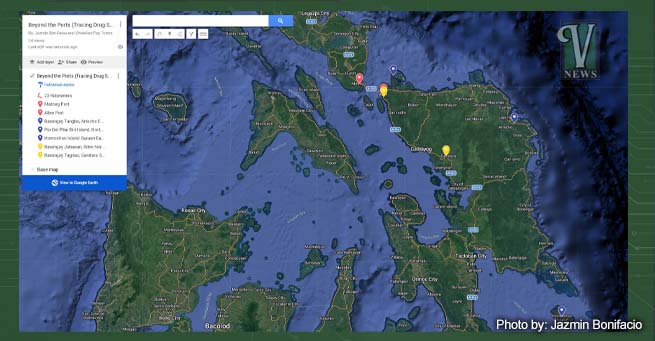
EXPLORE THE MARITIME CORRIDOR THROUGH OUR INTERACTIVE MAP
Click on the markers to discover reported drug seizures across Eastern Visayas and read the stories behind the numbers


 Philippine, Australian Troops Hold Joint Training in Samar as 8ID Eyes End to Insurgency by 2027
 Northern Samar Prepares for El Niño as Drought Hits Households, Farms
 SeRVisyo Caravan Takes Center‑Stage for Eastern Samar’s 61st Founding Anniversary
 Separating Fact From Viral Fiction: Examining Claims Against Eastern Samar Provincial Hospital
 Who Holds the Reins? Calbayog Pushed to the Margins in a 20-Billion Renewable Energy Venture (3/3)